Tuesday, June 16, 2020

Final Project - Hobbitiads

This is part of Hobbitiads, the final project submitted by Luis Felipe Martins and Felipe Martins. It concerns the departure of Sam from Middle Earth. The episode of his departure was inspired by the Adamastor episode in The Lusiads.


Olhando a oeste vejo grande embate
dum lado, a lúcida alta pluma
do outro, a joia de alto quilate 
da costa agora envolta em bruma.
Que a luz poente na onda refracte,
a íris caia na jocosa espuma
e guie meus olhos ao horizonte
aonde não existe uma ponte.

Como Lothlórien cortou a água,
brilhante navio de árvore encantada,
vou aonde pouca onda deságua.
Com Cirdan vejo Lissuin brotada,
sua pétala a tristeza enxágua:
com beleza ainda não cantada
sua proa às ondas cantaria,
a vela com o vento dançaria.

Mesmo com o mundo arredondado,
por breve visão de Aman busco
eu já por saudade inquietado
além de duas flores fico lusco:
Ao Caminho Estreito destinado,
meu coração com choro já ofusco,
O calor e dulçor de cada queria
ou pensando na outra me perderia.

Sabendo que o perigo vai ser grande,
que as ondas de Ulmo logo me guiem
e perto d'alva costa ele as abrande, 
d'onde Frodo e seu frasco m'auxiliem:
'como Earendil antes o fez, ande!'
Já ao mar por terra dos que sorriem.
Sem certeza de ser lá recebido,
mas com esperança, destemido.

Porém poucos Sóis já eram passados
Que daqui nos partíramos, cortando
Os mares nunca antes navegados,
os ventos fortemente assoprando,
Quando por Ulmo lá fomos pasmados:
Na cortadora proa vigiando,
Um Corpo que tudo ensombrecia,
Sobre nossas testas aparecia.

E disse: 'cometeram grandes cousas',
- Bramindo, o negro mar de longe brada -
'E navegar meus longos mares ousas,
mais que tantas outras, ó gente ousada:
Sobre qual imortal causa repousas
tu que vens nessa única jornada,
pois vens ver tais segredos escondidos
A nenhum grande homem concedidos.'

Eu levanto as mãos ao temente coro
do mar que chegar longe nos deixou.
'Que grandeza tem tais cousas que choro
trouxeram a mim que grande não sou?
Em Elbereth espero o vindouro,
e por ela que nos esperançou,
Bramindo longe, que o mar nos leve
à Aman mesmo que por tempo breve.'

Que com tal choro, a figura suma
sem rugir, que venha onda sutil
para nos levar em sua leve espuma
já a terra da árvore mais fértil.
Mesmo que o tempo todos consuma,
Com Frodo hei de ver a mais gentil,
Elbereth, vejo as folhas d'outono,
o céu anil até chegar o sono.
Looking west I see a big brawl:              
the lucid wave standing tall
against the rocky coast's strong fist,
a high carat gem shrouded in mist.
The wave the sunset affects,
to the jocose foam the iris directs
and along the horizon it guides my eyes
to the place which no bridge ties.

As Lórien through the water rip,              
brilliant enchanted tree ship,
I go to where there is no route.
Taking after Cirdan, I see Lissuin sprout,
My sorrows washed by its petals young
with a beauty yet unsung
Its prow to the waves would sing,
and its sail with the wind would spring.

Even with the world made round,           
To desire a peek of Aman I'm bound
For two flowers only have I mind,
I'm restless as I long for each kind:
To the Narrow Way destined,
my weeping heart is stunned,
Between Elanor and Lissuin crossed,
thinking of the other I will get lost.

Knowing that danger will be great,            
let the waves of Ulmo bring me sweet fate,
take me to the Shore and make them slow,
Then help me Frodo with phial aglow
"as Earendil before, do come!'
Out to sea and to the land of blossom.
Unsure if I will be welcomed there,
but with hope forth I fare.

But few Suns had gone past                         
Since from land I departed at last
through seas never sailed yonder,
the blowing east wind ever bolder,
suddenly Ulmo blocked the way:
As the prow cut through the grey,
upon me a great shadow was cast
and from the sea a giant body rose fast.

It said, "You've accomplished great deeds.  
- roaring, the black sea from afar pleads -
'And to sail my long waters you dare,
more than others, boldly you flare:
On which immortal cause do you rest
you who come on this great quest,
for you long to see secrets hidden
To no great man ever given.'

I raise my hands to the fearful choir           
from the sea that let me thus far inquire.
'What greatness has such things that brought
tears to me, who am not a great lot?
In Elbereth I await the coming fate,
and for the Lady who gave us hope innate,
bellowing far away, may the sea us present
Aman, even if for a short moment.'

With such weeping, may the figure vanish  
may a subtle wave come, I wish
to take us in its light foam
to the most fertile tree's home.
Even if everyone is consumed by time,
With Frodo I shall see the most fine,
Elbereth, with the autumn leaves falling,
Under the cerulean sky till I start yawning.

Sunday, June 14, 2020

The Fundamental Religiosity of Tolkien's Work

In our last class, Professor Fulton-Brown asked the question: “Where are you now in your thinking about Tolkien?” In this last blog post I suppose I’ll try to answer that question for myself. Coming in to this class, I obviously had my own thoughts and feelings about the Lord of the Rings and the greater universe of Middle-Earth, that mostly centered around specific characters of the books and their individual relationships. My favorite two characters in the series are Legolas and Gimli, who begin as fierce enemies, yet over the course of the tale they overcome the history of their two peoples and become close friends, a smaller plotline that is still very endearing. However, as we journeyed through the various other works and letters of Tolkien, I found my view of the Legendarium expanding quite a bit.

As a fan of Tolkien I’d of course always known that Tolkien was deeply religious and I could see that in some aspects of the Silmarillion (his version of the Creation story for one), but to be honest I wasn’t expecting, or rather I’d just never seen the deep religiosity that permeates through all of the Lord of the Rings. And, to be perfectly honest, I really like this aspect of Tolkien’s work. While there are instances of the author writing their own ideals into their stories which turn out to be pretty bad (insert J.K. Rowling here), I think that Tolkien’s expression of his religion and devotion in his work is pretty awesome, to be frank (though I may be biased because I too am religious). And the themes of religion and spirituality in the Lord of the Rings are more than just a reflection of the author’s own life and experiences, they’re also Tolkien sending a deliberate message in his work, one that is fundamentally religious, and also fundamentally hopeful.

A passage in “The Return of the King” that we read in class I think speaks to this point very well, when Sam sees a star in Mordor: 

There, peeping among the cloud-wrack above a dark tor high up in the mountains, Sam saw a white star twinkle for a while. The beauty of it smote his heart as he looked up out of the forsaken land, and hope returned to him. For like a shaft, clear and cold, the thought pierced him that in the end the Shadow was only a small and passing thing: there was light and high beauty for ever beyond its reach. (Return of the King 211).

Even in the darkest, most hopeless part of their journey, Sam sees the beauty of a star and is reminded that there is still good in this world. And the wisdom of that is, I think, something deeply religious/Christian. Christ’s sacrifice on the cross forgave humanity for their sin, and in doing so gave us all hope for a world free of it. Because of the crucifixion, mankind was saved, and even in the darkest of times, there is a higher power, a Good that watches over us and can never be extinguished.

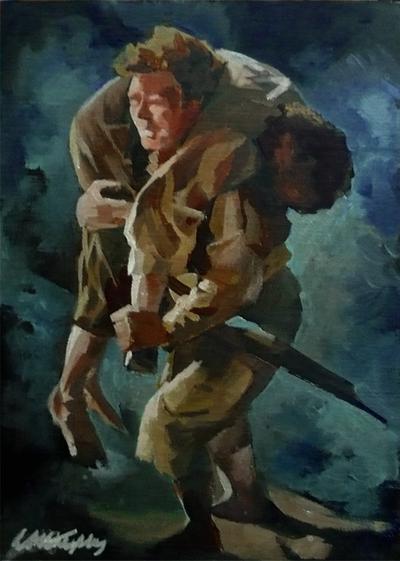
This is exemplified in Tolkien’s deeply religious concept of the ‘eucatastrophe’ from his essay “On Fairy Stories.” According to Tolkien, the eucatastrophe “denies...universal final defeat and in so far is evangelium, giving a fleeting glimpse of Joy, Joy beyond the walls of the world, poignant as grief” (On Fairy-Stories 86), and in Letter 89, he says that the Resurrection of Christ is the greatest eucatastrophe because “[it] produces that essential emotion: Christain joy which produces tears because it is qualitatively so like sorrow.” There are many moments near the end of the Lord of the Rings that I think would qualify as a eucatastrophe (Sam carrying Frodo up Mt. Doom for one), but I suppose the point I’m trying to make here is that this concept of the eucatastrophe being such a fundamental part of the fairy-store and thus of the Lord of the Rings, is part of what makes this tale very fundamentally religious and also so incredibly hopeful. This whole idea of good always triumphing over evil in the end, the idea of eucatastrophe, is deeply rooted in Tolkien’s religious beliefs, subsequently shaping the entire story of the Lord of the Rings and the Legendarium as a whole.

Sam carries Frodo, by Lorna-Marie

To that end, I have found that the fundamental religiosity of Tolkien’s work has changed the way I read and understand his stories, but in a very good way. Of course, the Lord of the Rings was still very meaningful to me before I gained a deeper understanding of Tolkien and his religious beliefs and how his work expressed them, but in learning about these things and appreciating them, I’ve found that the text resonates even more with me and the way I interact with it. My takeaways from the text before were ideas about character relationships and constructing a complex high fantasy world, and now adding this new perspective of religion has solidified the message that I think Tolkien is impressing upon us in my own mind: that despite the darkness that exists in and around us, there is always good in the world, and there is always hope for a better future.

-CR