Thursday, May 4, 2023

The Significance of Smaug

        We discussed the issue of dragons, monsters, and why they frighten us, and why they're important, but we ultimately walked away from the discourse without an answer. Thus, I am attempting to discover more about the significance of dragons in Tolkien's mythos. In the spirit of fair warning, I haven't read all of the dragon lore that exists, even in Tolkien's realm, but even within Tolkien, there isn't much of it. I will mostly focus on what I can extrapolate about the role of dragons based on their depiction in The Hobbit. Thus, it is an important caveat that The Hobbit was not originally written as part of the complete saga of Middle-Earth, although it was later modified to fit into the context of The Lord of the Rings. Given this, some aspects of The Hobbit may not be entirely consistent with the rest of Arda's lore; however, since The Hobbit is considered to be canon and treated as such, I will consider it the same way, and mostly just study the dragon Smaug. I have found that Smaug shares many similarities with Fëanor, Morgoth, and Sauron, which implies a connection between them. Ultimately, Smaug, and other dragons in Tolkien's mythos, are a personification of the corrupting force of greed, and an extension of Morgoth's corrupting influence.

        First, let us look at the traits dragons exhibit. Smaug is massive, a scaled flying beast who breathes fire and hoards gold-- very standard dragon traits. There are other physical traits, as well: he has red eyes, is probably slimy, at least on his underbelly, is functionally immortal, and actually glows just a bit (The Hobbit, 348, 378, 52, 338, respectively).* These traits probably aren't as important, however, as Smaug's behavior. Thorin says of Smaug, 

"Dragons steal gold and jewels... from men and elves and dwarves, wherever they can find them; and they guard their plunder as long as they live ... and never enjoy a brass ring of it. Indeed they hardly know a good bit of work from a bad, though they usually have a good notion of the current market value; and they can't make a thing for themselves, not even mend a little loose scale of their armor" (The Hobbit, 52).

This information is very significant, because it frames a fundamental aspect of Smaug, and dragons in general (and it's an aspect that exists outside of Tolkien's mythos as well. The dragon Fafnir and the unnamed dragon from Beowulf both had hoards). It tells us a few important things about Smaug's behavior: first, he steals gold and jewels from men, elves, and dwarves, indiscriminately. Second, he hoards his treasure fiercely, but without appreciation for its actual beauty. He just enjoys the possession of it, the sense of ownership over the thing considered valuable (i.e. things with good market value). In fact, he is actually rather incapable of determining the beauty of an object, since he can't tell "a good bit of work from a bad" (The Hobbit, 52). 

        This behavior is eerily consistent with that exhibited by Fëanor, with the Silmarils. Although Fëanor was once noble, soon after his creation of the Silmarils his admiration of their beauty quickly becomes an obsessive lust. "Fëanor began to love the Silmarils with a greedy love, and grudged the sight of them to all save [a few]... he seldom remembered now that the light within them was not his own" (The Silmarillion, 71). Then, when the Two Trees are killed, Fëanor refuses to destroy the Silmarils to revive the trees (The Silmarillion, 84). Finally, after Morgoth steals the Silmarils, Fëanor vows to slaughter anyone who possesses a Silmaril in bloody vengeance. (The Silmarillion, 90). His traits sound very draconic, including his envious rage over the idea of others possessing or even seeing the Silmarils. Furthermore, at the point where he begins to forget that "the light within [the Silmarils] was not his own" (The Silmarillion, 71), he begins to see them as something other than what they are. This could easily include him forgetting their beauty, and Tolkien writes in his poem "The Hoard" that this is often the case with those who obsess over treasure. In the poem, he describes an old Dwarf who works his whole life over a pile of jewels and precious metals, making beautiful items, but in the end, his obsession for the trinkets overpowers his actual appreciation for their beauty, as well as his pride in their creation ("through his bony claw with a pale sheen / the stony jewels slipped unseen") ("The Hoard," stanza 2). "The Hoard" demonstrates the infectious power of greed, and while the poem includes a dragon, it also features Dwarves, Elves, and Men, showing that "draconic" behavior is not limited to the dragons themselves. Other beings are very much capable of falling prey to greed and gold-lust.

        Smaug actually has a special power in this regard, that essentially corrupts any pile of treasure that a dragon might hoard. The Dwarves, once holed up in the Lonely Mountain, soon find themselves falling prey to this "dragon-sickness," demonstrated through the ominous warnings about "the power that gold has upon which a dragon has long brooded, nor with dwarvish hearts" (The Hobbit, 412).** The Master of Laketown also falls "under the dragon-sickness, and took most of the gold and fled with it" (The Hobbit, 472). Not only does Smaug hoard treasure with a jealous rage, but he also has the power to spread that covetousness to other people. Even Bilbo, who is remarkably level-headed and disinterested in treasure, feels the effects of the dragon-sickness when he first encounters the treasure (The Hobbit, 339-340). This power does not have much significance beyond its ability to spread greed when Smaug is compared with Fëanor, but it suddenly gains much more significance when Smaug is compared with Morgoth, and Sauron.

        One key difference between Smaug and Fëanor is that while Smaug covets the things that others make, Fëanor is possessive over "these things that he himself had made" (The Silmarillion, 70). His evil is much more like Morgoth's, then, whose fall into darkness also lies largely in his greed for other people's creations; when Arda was being formed, Melkor "coveted it, and he said to the other Valar: 'This shall be my own kingdom; and I name it unto myself" (The Silmarillion, 10). Later, the last straw before Melkor wages war against the Valar is when he sees that the Valar have taken beautiful physical form, and "his envy grew then the greater within him" (The Silmarillion, 11). At that point, he no longer appreciates the beauty of Arda. Otherwise, he would not have bent himself to destroying it. Like Fëanor, and like Smaug, Morgoth covets something, and hates the fact that others have it or want it, but unlike Fëanor, Smaug and Morgoth seem ultimately unable to create things for themselves. It's a good thing, too, in the case of Smaug, since an ability to "mend a little loose scale of [his] armor" (The Hobbit, 52) could have saved him from being shot in the heart by Bard the Bowman (The Hobbit, 389-390).

        Thus, in that context of their shared motivation, another key comparison between Smaug and Morgoth is this: at one point, the Dwarves Fíli and Kíli discover musical instruments in Smaug's horde, which are miraculously "untouched by the dragon, who had small interest in music" (The Hobbit, 374). Given the overarching theme of music in Tolkien's mythos, this small detail is actually very significant. Of course, Smaug has no interest in creating music, whereas Morgoth once wished to create music of his own, but Morgoth's priorities and desires have changed. Smaug has, in all likelihood, never been interested in making music at all, which shows a slight difference in their nature. I suspect that this difference is due to the fact that dragons were servants of Morgoth in the Elder Days (The Silmarillion, 229-230). Smaug, while autonomous, is not a creator, and he has never desired to be. His purpose lies in something far different.

        Dragons, including Smaug, have a relatively unique and very dangerous power, known as the "dragon-spell,"*** which Smaug uses on an invisible Bilbo Baggins in an attempt to coerce him to "rush out and reveal himself and tell all the truth" (The Hobbit, 352), and, slightly earlier in the encounter, turn Bilbo against his friends (The Hobbit, 351-352). As a class, we've discussed the corruptive power of the Ring, and the fact that it doesn't really do much to its bearers other than talk to them. The Ring, as an extension of Sauron, has great power in words, just like how Sauron caused Númenor to fall into evil simply through his skill with speech (The Silmarillion, "Akallabêth"). Fëanor, too, is "a master of words, and his tongue had great power over hearts when he would use it... fierce and fell were his words, and filled with anger and pride; and hearing them the Noldor were stirred to madness" (The Silmarillion, 88). He uses his power to convince the Noldor to slay their kin. It is no coincidence that Smaug shares this power, this verbal magic of a kind that causes people to reveal themselves, brings out their worst sides. Smaug is a perpetrator of evil not just in his greed, but in his ability to manipulate, twist, and corrupt both with his words and with his "overwhelming personality" (The Hobbit, 354). 

        All of these details suggest that Smaug, and by extension all dragons, are incarnate extensions of Melkor's corruptive power. The end of The Silmarillion reveals that while Morgoth may be defeated, his lies "will bear dark fruit even unto the latest days" (The Silmarillion, 306). Smaug's significance, then, is that he is the manifestation of Morgoth's lingering power on Middle-Earth. He is an extension of Morgoth's will, even while he is an autonomous being. He is utterly disinterested in creating things of his own, which means he is in a perfect position to serve Melkor's purpose; if dragons were focused on creating their own things, it would be far less likely that they are spreading Melkor's evil, and they would be more their own, separate malevolent entity. That can't be the case, anyway, because no matter how powerful dragons are, they were still part of Morgoth's plans. There is most certainly more to dragons than this facet of their being, but it seems clear now that part of that role includes being an incarnation of that corruptive influence. It would probably take several more papers to explore dragons fully, however.

--GCE

*I am using an ebook version of The Hobbit to cite, so the page numbers may be slightly inconsistent with a print copy. The edition I am using is the ebook version of the "new reset edition" of the 1995 edition.

**The fact that there is an actual title for this affliction, and the assumption that other, more informed people would know about the risks of engaging with a dragon hoard, any dragon hoard, both point to the idea that this is a trait shared by most, if not all, dragons.

***IBID

What Keeps You Up at Night?

When one thinks of the things that inhabit their nightmares, torment their minds, and drive them into deep states of fear, what does that thing look like? In order to truly strike fear into a reader or viewer, one first needs to understand the ways in which to build a perfect villain, or in most cases, a monster. This is one of the key elements that gets analyzed in “Beowulf: The Monsters and the Critics.” Beowulf itself is one of the first key stories that portrays a monster in its most terrifying way. Grendel, Grendel’s mother, and the dragon are terrifying to the reader, but why? One possible answer is that monsters are mystical and mythical. But a rebuttal to this notion is that in reality monsters are so terrifying to humans because of their earthly traits, not their mystical ones. For example, let’s examine Tolkien’s dragon Smaug in The Hobbit, or There and Back Again. Smaug, unlike some of Tolkien’s other dragons who may have some redeeming or even nonviolent character traits, is a true incarnation of evil and terror amongst those in his domain. Smaug made his home in the lonely mountain, feeding into his greed and desire for power by claiming all the gold, jewels, and precious metals left behind in the mine. Smaug slaughtered the previous dwarven inhabitants, slaying almost all members of Dale and sending those few who did escape into exile (many of whom found a new home in Lake Town), below the mountain. This is the background that is given to readers of The Hobbit, or There and Back Again. But still the question persists, why are we so terrified of Smaug?

In truth, what makes us so terrified of these dragons is the combination of their appearance and their raw and seemingly never ending power. In regards to his appearance, Smaug is so terrifying because as a dragon, he appears to be semi-realistic. Dragons look as if they could be a part of the reptilia class on Earth. Dragons have scales, snake-like eyes, claws like lizards and a tongue like a snake. But what separates them and makes them so truly terrifying is the inclusion of non natural characteristics, which in this case are a dragon's wings. Coupling the introduction of wings with the size of the dragon is what gives it the necessary characteristics to be deemed a monster. A similar monster that Tolkien introduces is Shelob, the giant spider that attacks Frodo and Sam on their journey to Mordor. Since for many people who experience arachnophobia spiders are already terrifying enough, all Tolkien had to introduce to make Shelob the perfect mythical monster was to dramatically increase the size. Through not only reading about the characteristics of Shelob, but also seeing the monster in the movie adaptations of the books, it was easy to be terrified of Shelob.

There are other ways in which to make a monster not only terrifying but intimidating as well. Tolkien demonstrates this through his creation of Orcs. Orcs take on a demonic representation of the human figure. They are ugly, large, dirt, and intimidating versions of humans. Though some overlook them as just pawns in The Lord of the Rings they too are also fearsome monsters. One of the key characteristics of all of these monsters found not only in The Hobbit, or There and Back Again but also in The Lord of the Rings is their unnatural appearance, and thus they become hard for the mind to grasp and understand. It is this that makes them so terrifying. Things that the human mind cannot grasp is what terrifies it the most. So, creating monsters that flirt with that line is extremely powerful. They are earthly enough and contain real world characteristics that make them seem realistic, while also having features that make them seem majestic and otherworldly. Through this dichotomy that was first explored in Beowulf, Tolkien creates his own monsters that dominate the stories and haunt the nightmares of not only the characters but the readers and viewers. 

Monsters and heroes have been prevalent through almost all stages of humanity and storytelling. For example, monsters are deeply rooted in the Christian faith. Many times in the Bible, especially in the book of Jobe, there are depictions of saints and angels fighting demonic monsters and thus saving not only themselves but others. Almost every time in Christian writing, monsters represent sin, and it takes a hero to fight off this sin. Sin is such a powerful tool in the Christian depiction of monsters because for many people who practice the Christian faith, sin and committing sins is something that is greatly feared. Thus, one can even see how Jesus Christ himself is a monster slayer. This epitomizes how drawn humans are to the monster slayer stories, and just like in Tolkien’s stories, the Christian faith has many dragon slayer stories. Take for example St. George and St. Michael, both of whom have stories written about them slaying dragons and becoming a hero. So, what does it take to become a hero? Is the destruction of a monster necessary? These questions have persisted throughout fantasy writing and were closely examined by Tolkien in note only his personal notes and books.

TJG

Build-a-Monster Workshop: What Makes a “Good” Monster?

    
The art showcased here is a from a great comic series, Once & Future written by Kieron Gillen and pencilled by Dan Mora. The series is about great literary figures, like the pictured King Arthur and Beowulf, coming to life as monsters, hence their apperances here. 

While I am using this art partially because I am a fan of the series and especially Mora's art (and it's relevance is giving me an excuse to include it!), I also think the irony of turning Beowulf into a monster is very fitting. Beowulf is the monster-slayer, and we've tried to pinpoint why monsters—and their accompaining slayers—are so important for stories. But, we did not discuss the next question: what makes a "good" monster? Good, in this context, meaning fulfilling their role, not being on the side of the Angels.

What I want to try to do is put forth a possible framework for what makes a good monster, supported with examples from the Legendarium. By no means do I think this is entirely "correct" or "definitive" in any way; rather, I want to discuss what makes a monster compelling once we have accepted their overarching role in these stories.

We begin with the first necessary characteristic:

1. Powerful


There is a phenomenon in video games, especially turn-based roleplaying games (most of which are fantasy-themed!), where as you play the game, your characters level up and become more powerful, making early-game enemies much less of a threat. For example, consider the iconic Slimes from Dragon Quest. And while these certainly serve their purpose, the monsters I want to speak of, in the model of Grendel or dragons, must be powerful, like bosses in the aforementioned video games. Tolkien says "But we may remember that the poet of Beowulf saw clearly: the wages of heroism is death" (The Monsters and the Critics, 26). Therefore, heroism and the death heroes face would not mean anything, nor likely would even occur, if monsters were weak. There would be no reason to fight them, or little danger in doing so, since they pose such a small threat.

To see this power, consider Smaug. He is a great dragon, and through his power he nearly decimates Laketown with very little effort. Shelob similarly fits the criteria, a giant spider that attempts to crush Sam undernearth her weight. Additionally, she has webs so strong only elven blades were able to cut them, and a paralyzing venom to stun her prey before she eats them.

2. Terrifying


A monster should strike fear into the hearts of anyone facing them. This does pair with power, since a powerless monster is unlikely to be particularly frightening, but is separate. Power itself is not necessarily inherently scary. Gandalf, for example, is powerful, but not terrifying. Likewise, the Ainur and Valar (minus Melkor) as well as Iluvatar are extremely powerful, but not scary in the way a dragon would be (noting a difference between "fear of God" and "fear of monsters").

In this category, Shelob certainly reigns supreme. Humans already tend to have an aversion to spiders, so a giant, unabashedly-evil one would certainly strike fear into most people. Smaug does have some similar traits, though, with dragons resemblance to snakes and the inherent terror of a hulking beast of immense power.

3. Resilient


This, again, is tied to power, but is not the exact same thing. If a monster was defeated in a single, non-chalant hit, that would make for a very boring threat. There are even stories crafted around this concept, such as One-Punch Man. A monster needs to be hard to defeat, a challenge for the hero, a feat. The dragonslayer is not great because it is easy, but precisely because it is so difficult.

Shelob and Smaug certainly have this, with Shelob and her webs being nigh-impenetrable and Smaug being immune to spears and arrows, but both also have clear and exploitable weaknesses, Shelob's eyes and Smaug's bare patch. This makes them possible to defeat, albeit very difficult.

4. Evil


Finally, a monster should be evil. That is the fundamental difference that separates a monster from just a normal creature. When a lion kills its prey, it is doing so because it is its biological imperative to survive. But a monster acts because of its evil nature.

This can be seen very in both Shelob and Smaug. Shelob is described as 

an evil thing in spider-form... she served none but herself, drinking the blood of Elves and Men, bloated and grown fat with endless brooding on her feasts, weaving webs of shadow; for all living things were her food, and her vomit darkness. Far and wide her lesser broods, bastards of the miserable mates, her own offspring, that she slew, spread from glen to glen, from the Ephel Dúath to the eastern hills, to Dol Guldur and the fastnesses of Mirkwood. But none could rival her, Shelob the Great, last child of Ungoliant to trouble the unhappy world (The Lord of the Rings, 313).

While not as viscerally evil, Smaug destroys Laketown in vengeance and is extremely greedy and proud.

Thus, we have a description of a monster: powerful, terrifying, resilient, and evil. Again, I don't think this is the "definitive description" or anything of the like, and plenty of monsters don't quite fit this definition (the Goblin King is strangely easy to defeat, and Gollum has very monsterous characteristics but is not particularly powerful). But I think this is a good starting point for "great beasts to be slain" type monsters.

Now, having created this definition, I want to show how it characterizes Sauron as a great, if not the greatest, monster, through the use of the Nazgûl. As I showed in my previous blogpost, Tolkien cultivates Sauron as the ultimate evil, so theoretically that should remain the case here.

The first characteristic is powerful, and the Nazgûl certainly qualify there. Just with one stab of the Morgul-knife, Frodo was on his way to becoming a wraith, and "[Frodo] felt that he was commanded urgently to halt. Hatred again stirred in him, but he had no longer the strength to refuse" (The Lord of the Rings, 214). They were able to command after this as well, so they certainly are extremely powerful.

Second is terrifying, and this holds even more true. The imagery alone shows the horror of their appearance:

Soon there could be no doubt: three or four tall black figures were standing there on the slope, looking down on them. So black were they that they seemed like black holes in the deep shade behind them. Frodo thought that he heard a faint hiss as of venomous breath and felt a thin piercing chill. Then the shapes slowly advanced... In their white faces burned keen and merciless eyes; under their mantles were long grey robes; upon their grey hairs were helms of silver; in their haggard hands were swords of steel. Their eyes fell on him and pierced him, as they rushed towards him… The third was taller than the others: his hair was long and gleaming and on his helm was a crown. In one hand he held a long sword, and in the other a knife; both the knife and the hand that held it glowed with a pale light (The Lord the Rings, 196).

And, very fittingly, the primary tool of the Nazgûl is fear.

Third is resilient, and this likewise holds true. When initially being pursued by them, Frodo and the others have no ability to fight them, only to hide. On Weathertop, Aragorn attempts to use fire, which seems to help but certainly doesn't defeat them. And though some are swept away by the river, they are certainly not killed. This is not to say they are impossible to defeat, as the Witch-king of Angmar is defeated individually and not with the destruction of the Ring, but it is extremely difficult.

Finally, evil. This feels well summed up in everything before. Their appearance, methods, and weapons are all pure evil. Plus they serve the ultimate evil, so they certainly qualify.

So the Nazgûl are great monsters. But that is not what is particularly important. The Nazgûl serve Sauron. They are chess pieces, albeit powerful ones, that Sauron is controlling, and controlling totally as they have no will of their own. Thus, without actually having to establish much about Sauron concretely, he is established as an extremely credible threat because he controls them. This is why my analysis focuses on Book I, since this is the establishing part before the threat is fully unveiled. The Nazgûl lead into Sauron, making Sauron a great monster.

To end off, some art from Once & Future of Grendel:

-CVB

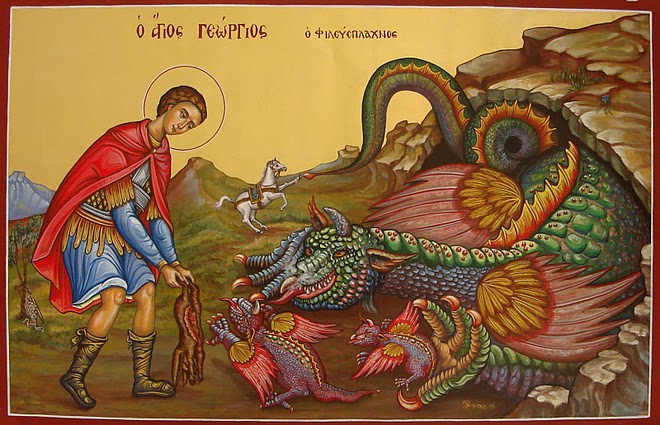
Smaug and Saint George


    Do you notice any similarities between these two pictures? Well, you should, because Bard the Bowman and Saint George are both dragon slayers.

    The Bible actually contains a surprising amount of dragons. Revelation 20:2 describes how the Archangel Michale "seized the dragon, that ancient serpent, who is the devil, or Satan, and bound him for a thousand years." Christ, himself, was depicted in the Late Antique and Medieval ages trampling on beasts, which often included a basilisk, serpent, or dragon. In fact, the idea of monsters and dragons was frequently seen in Medieval Christian Europe. Tolkien himself claims that "in England this imagination [monsters] was brought in touch with Christendom, and with the Scriptures" (Tolkien, The Monsters and The Critics). The most famous of these Anglo-Christian dragon-slayers, however, was Saint George.

    In the story of Saint George and the Dragon, Saint George is given the magic sword Ascalon, which is capable of slaying anything it touches, by an evil witch, who he ends up defeating through trickery. George then sets out to slay an evil dragon so that he might save the princess of Egypt and gain, through the promise of King Ptolemy of Egypt, her hand in marriage and the crown of Egypt.  He ends up slaying the dragon, marrying the princess, and inheriting the crown of Egypt.  Had he not returned to England with the princess George would have ended his story as a king.

    The story of Saint George is mirrored in Tolkien's story Farmer Giles of Ham, albeit in a more comical depiction. Farmer Giles also beats an initial enemy through trickery, even if it was unintentional, and receives the dragon-slaying sword Caudimordax, or Tailbiter. Giles then sets out to fight the dragon Chrysophylax and beats it into submissions. Giles then uses the dragon to secure his status as a king in his own kingdom. While this story could be interpreted as a parody of Beowulf the similarities to Saint George seem stronger, so for the sake of this argument I will assume that Giles is Tolkien's version of Saint George.

    Considering the comparison between Giles and George, are we then able to link Tolkien's dragons to other stories in the Christian tradition? If farmer Giles is Saint George, who then is Bard the Bowman? Well, he is the son of the Lord of Dale who was the only one who could slay the dragon, and it is he who leads the army of men into the final battle (in The Hobbit) against evil in the Battle of the Five Armies. This seems very similar to the story in Revelation of the Archangel Michael who is the son of the Lord of Heaven, who was tasked with slaying the dragon Satan, and it is he who leads the army of heaven in the final battle against evil. Does this then mean that Smaug is Satan?

    To answer this question, one must discover why Tolkien includes dragons in his stories. In The Monsters and The Critics, Tolkien attributes a special role to dragons as the great product of man's imagination claiming that "the dragon in legend is a potent creation of men's imagination, richer in significance than his barrow is in gold." For Tolkien, the dragon is the apex of a challenging foe, the hardest enemy that a hero can face, and "if the hero falls before a dragon, then certainly he should achieve his early glory by vanquishing a foe of similar order" (Tolkien, The Monsters and the Critics). The evolution of the hero to fighting a dragon is part of the reason why Tolkien holds the story of Beowulf in such high regard.

    The special role the dragon plays in a hero's story is why Tolkien gave unique names to many of his dragons (Chrysophylax, Smaug, Glaurung). The inclusion of unique names for these foes highlights the unique role they play in the story. The triumph of Bard seems greater when the line is: 

"Smaug shot spouting into the air, turned over and crashed down from on high in ruin" (Tolkien, The Hobbit),

rather than:

"the dragon shot spouting into the air, turned over and crashed down from on high in ruin."

    By naming the enemy, Tolkien has given gravitas to the accomplishment of Bard. The name "Smaug" carries with it the historical actions of Smaug, it reminds the reader of the destruction of Dale and The Lonely Mountain kingdom. If Smaug had just been "the dragon", the weight of his history would have been lost. The power of names has already been discussed in the realm of Tolkien, and combing that power with the narrative significance of dragons creates an immensely powerful foe for the heroes to combat.

    While I cannot say for sure, Tolkien's opinion of dragons as the greatest enemy, the best ones for the heroes to fight at the end of the story, seems to mirror the role of Satan in the Bible. Satan is the greatest evil in the Bible and the "final boss" in the narrative of the great fight against evil. Smaug holds the same role in The Hobbit, that Satan holds in the Bible, as the great evil that Bilbo and his group must defeat. The link between Bard and Michael has already been theorized, so it would make sense, if that were true, that Smaug must be Satan. Additionally, unlike most other dragons who Tolkien does not portray as evil, but rather just non-humanocentric, Smaug has the traits of greed and envy, two of the sins most prominent in Satan himself. Smaug, in this way, is special when compared to Tolkien's other dragons, and, therefore, I believe that Smaug is meant to be an allegory of Satan via how he is portrayed in The Hobbit.

Photo Sources: https://www.youtube.com/watch?v=5haX0SXvk1Q; https://www.pc-freak.net/blog/why-saint-george-is-depicted-on-icons-killing-a-dragon-an-ancient-story-of-saint-george-killing-the-last-dragon-a-collection-of-7-icons-of-saint-martyr-george/; https://www.dreamstime.com/stock-images-icon-st-george-image29686514

-CG

Monday, May 1, 2023

What is the One Ring and what does it do?

The subject of the meaning of the One Ring is perhaps the most important and widely debated topic among those who take an interest in the symbolism in Tolkien’s stories. Does it represent power, since those who gain it never wish to give it up and will devote their entire energies (and the fate of their souls and minds) into getting it back? Does it represent a drug of some kind, since it has an intoxicating and negative effect on its ‘users’ and is highly addictive? Is it perhaps suggesting that there is evil in all of us - with the chief protagonists of the story carrying a piece of Tolkien’s Satan with them at all times, both literally and symbolically? What do we actually know about this mysterious object? I will attempt to deal with these questions in this blog post.

Is the One Ring a representation of power itself? While this theory seems plausible at first (and is the one I held to until quite recently) a closer examination reveals it to be unlikely. First, the Ring (with a notable exception - Smeagol) seems to wield greatest power over those who are already powerful. The men of Gondor, particularly Faramir and Boromir (who are powerful within Gondor) are more affected than the Hobbits, and among the Hobbits it is the lowly Sam who is less affected than the high-born Frodo. Sauron is the most affected and he is the lord of arguably the most powerful realm in Middle Earth. The theory that the One Ring is power could still make sense, since often those with the most power are those who desire more. However, the Ring does not actually seem to offer power, merely the illusion of power. In practice it weakens, both mentally and physically, its users (see Smeagol, Sauron, Frodo). It offers delusions of grandeur, as with Boromir and Faramir, who both imagine that with the Ring they could do extraordinary things (despite no evidence that the Ring can do anything especially great besides turn its wearer invisible) but yields no tangible power to its users.

So, since the interpretation of the Ring as power seems to be weakened, perhaps we can understand it as a drug? We must consider two facts here. First, in the time at which Tolkien was writing The Lord of The Rings drug use was not nearly the issue it is today - with the obvious exception of alcohol. Therefore, unless the One Ring is specifically about alcohol, which seems unlikely given the total lack of comparison between the two and the fact that ‘users’ of the Ring experience something very unlike inebriation or drunkenness, it is not plausible that the LOTR was ultimately a diatribe against drugs. Second, the Ring does not seem to have any drawing power besides its literal drawn power - there is no good feeling or ‘high’ which it causes and which prompts further use, creating an addiction. It attracts its ‘users’ through attracting them, if that makes sense - St. Augustine said he stole fruit not because he enjoyed eating it or wanted it for any particular reason, but only because he felt the desire to commit an evil act. Similarly, the Ring offers no tangible positive outcome for its users, only pure attraction. It is also prudent to mention that the One Ring actually lengthens its users’ lives, it doesn’t shorten them.

Now let us consider the notion that the One Ring, having been forged by Sauron, is meant to be in essence a piece of him which the Hobbits carry around with them. What could this mean? This could be commentary on the part of Tolkien that the Hobbits, despite being the protagonists fighting for what is right, carry evil even within themselves. Unfortunately, this theory fails in a couple different ways. First, the notion that evil can be purged and destroyed, or perhaps more accurately ‘returned to Hell’ (the Ring is thrown downwards into a pit of fire), does not seem to agree with Tolkien’s Christian conception of evil, which sees evil as omnipresent in the world and not something which can be gotten rid of. Furthermore, if the One Ring represents the evil within each character, then why represent it as a single physical object which passes between numerous characters? 

While the above theory may not have succeeded in explaining the role of the One Ring, part of it may prove to be accurate: namely, that the Ring is a piece of Sauron which the characters carry with them and which infects them with his presence. Perhaps the best understanding of the Ring is as propaganda. The Ring acts as a piece of Sauron’s will not by physically forcing characters to do anything but to convince them through lies and deception. This interpretation helps to tie up the loose ends brought up earlier. The Ring works best on the men of Gondor because they come from a more sophisticated society which may leave them more detached from common sense and more susceptible to propaganda. Additionally, the One Ring offers power while giving none, clearly paralleling propaganda in that way. Like propaganda, and unlike drugs, there is no positive feeling originating from it, it uses negative manipulation in order to persuade or to call to action. The fact that Sauron himself is persuaded by and obsessed with his own propaganda can be seen as Tolkien’s suggestion that those who traffic in propaganda are often convinced by their own nonsense and that propaganda takes on a life of its own.

-LM