Saturday, April 8, 2023

Middle Earth: What Did Tolkien Mean?

 The debate over Middle Earth’s role has been active since the publication of The Lord Of The Rings. Some view it as allegory, a commentary by Tolkien on contemporary events in Europe, particularly the Second World War. Others see it as a mechanism for autobiography, a kind of reflection by Tolkien on his experiences in the First World War. Yet another view suggests that Tolkien was not only non-allegorical but entirely uninspired by any meaningful cultural or historical events or symbols, that he was merely creating a fictional world for entertainment; he was writing a children’s tale which could be enjoyed by adults. Another perspective views Middle Earth as totally inspired by various ancient mythologies.I will use Letters 151 and 183 in order to explore which of the many claims about Middle Earth, of which the above are just a few, are supported by the evidence and which are not. 

In letter 151, part of a longer text addressed to Hugh Brogan, Tolkien notes that “Middle-earth is just archaic English for [...] the inhabited world of men” (Letters, p. 186), expressing that he sees Middle Earth as historical in an almost literal sense. He is careful to clarify, though, that The Lord Of The Rings contains both “legend and history” (Letters, p.185) and should therefore not be seen as some kind of fictionalized capturing of real-world history. Furthermore, Tolkien regrets, in the same letter, overloading Book 1 with “too much [...] setting and historical background” (Letters, p.185), which would certainly be a bizarre view for an attempted historian to take. Letter 151 informs us that we cannot take The Lord Of The Rings as some kind of historical document, although it is inspired by real history.


Letter 151 only briefly, and almost as an aside, dealt with the issues of historicity and Tolkien’s intentions. Letter 183, meanwhile, includes a much more substantial and direct look at his motivations. While letter 151 deals with the topic of impersonal, far-back history in relation to The Lord Of The Rings, letter 183 tackles the relationship between Tolkien’s personal history and his work. While Tolkien readily admitted a mixture of history and legend in Middle Earth, he stoutly rejects any attempt to read his stories as autobiographical. He writes that he has “never thought of trying to ‘objectify’ my personal experience of life” (Letters, p.239) in The Lord Of The Rings. He goes on to say, in even more clear fashion, “The story is not about JRRT at all, and is at no point an attempt to allegorize his experience of life” (Letters, p.239). It is hard to imagine a clearer rebuttal of the ‘autobiography’ camp and seems to attack those who would view Tolkien’s writings as allegory generally. A renewed assault on the ‘allegorizers’ is taken up shortly thereafter, where Tolkien writes that “Middle-earth is not an imaginary world [...] The theatre of my tale is this earth, the one in which we now live, but the historical period is imaginary” (Letters, p.239). Here, Tolkien continues the theme from letter 151, in fact reiterating the linguistic legacy of the term ‘middle-earth’ in that same quotation. We again get the sense that Tolkien intends Middle Earth to be a kind of halfway-point between history and legend, one which blurs the line between strictly historical and magical fairy-tale. Tolkien goes on to talk about Beowulf, through an indirect comparison to The Lord Of The Rings whose specifics are not important - the point is that he strengthens on the one hand the historical nature of the story and on the other its links to mythology and fiction.


Tolkien concludes letter 183 with a very significant section on his work’s relationship to Christianity. He writes that Sauron approximates Satan because both of them fell from goodness as a result of pride: “Satan fell. [...] Sauron [...] had gone the way of all tyrants: beginning well [...] But he went further than human tyrants in pride and the lust for domination, being in origin an immortal (angelic) spirit” (Letters, p.243). Tolkien’s comparison here seems to strengthen the by now heavily damaged allegorical cause; Sauron seems to be a pretty direct allegory for Satan. He goes on to say that his work is fundamentally “about God, and His sole right to divine honour” (Letters, p.243), which Sauron attempts to usurp in a sort of Satanic revolt. Tolkien also doubles down on the ‘realness’ of his story in this section, writing that his critics view him as “simple-minded” and “adolescent” (Letters, p.244) for representing the ‘good guys’ as unfailingly moral in every way, which he refutes with reference to Denethor, going on to say that his world “is not an ‘imaginary’ world, but an imaginary historical moment” (Letters, p.244). This statement supports and is supported by his writing shortly before that, as a Christian, he does not “deal in Absolute Evil” (Letters, p.243). Representing any character as either perfectly good or perfectly evil, even individuals like Gandalf or Sauron would violate the Christian nature of the story - no mortal can be perfectly good, for that is the reserve of God, but equally no mortal can be perfectly evil; after all, even Satan fell.


Tolkien’s letters shed light on his complex relationship to his own work. He seems to be engaged in a kind of balancing act, not wanting to be overly historical, or obsessed with a kind of historical accuracy, but also not wanting to write detached fiction. The absurd and fictional elements of the story are grounded in and by the English language, historical mythology (like Beowulf) and a Catholic worldview. The only view of those presented at the beginning of this post which we can say with certainty is false is that which says that The Lord Of The Rings is personal allegory on the part of Tolkien. Tolkien, who was engaged in a grand project of historical recovery and documentation would probably view his own experiences to be vanishingly unimportant in the face of civilizational myth-making. 


-LM


Thursday, April 6, 2023

Of Aragorn and Tinuviel

 ‘I will tell you the tale of Tinuviel,’ said Strider, ‘in brief – for it is a long tale of which the end is not known; and there are none now, except Elrond, that remember it aright as it was told of old. It is a fair tale, though it is sad, as are all the tales of Middle-earth, and yet it may lift up your hearts.’ — Lord of the Rings, bk. I, chap. 11


After informing the hobbits with such words, Aragorn broke into a song about Tinuviel, or Luthien, the elven maiden who fell in love with the mortal man Beren, who came one day wondering lost in the forest where she was dancing with music. Together they fought the dark lord Melkor and won a Silmaril to be Luthien’s bride-price to her father Thingol. In the end, Luthien abandoned her immortal life for Beren, and they “passed away in the forest singing sorrowless” as the last stanza of Aragorn’s song suggested.


There is a lengthier passage on the story of Beren and Luthien in “Lay of Leithain” in the book Lays of Beleriand, but here I will not examine the similarities between both songs. Aragorn was introduced as “Strider” to the hobbits, and he was called so in this part of the narrative. But later, he was revealed to be the heir of Isildur, the king who once fought Sauron and took his Ring. As Tom Shippey notes in J.R.R Tolkien: Author of the Century, Aragorn was skilled in speech and flexible in style, able to switch between identities. As “Strider”, he might tell the hobbits any experience he had in the north, or yield to Merry, who wished to hear about Gil-galad. Why did he choose this tale? It is also interesting to observe that after hearing the song, the hobbits did not directly respond to it. Possibly they did not fully realize the message or were simply too tired to give any sign.


In structure, Tolkien may have foreshadowed Strider’s identity at this point, of which more elaboration and connection with the elven-world were revealed later, especially at the Council of Elrond where he openly declared kinship and kingship to Boromir. Here, the hobbits knew only that Strider “knew many histories and legends of long ago” and it remained a mystery of who he really was. The readers would be puzzled also, waiting for the author to show the “trick”, the truth behind. But if the readers choose to re-read this part, like a puzzle solved, they would notice Tolkien’s embedded hint. 


Fearing that I may over-interpret, I have to say that although much can be analyzed through a simple song, the song itself did not aid the protagonists in any obvious way. But alas, I believe that Aragorn was singing a song of man, of elf, of love, beauty and sadness. He was the one that led Frodo through danger at the inn, through darkness and enemies, and brought him to Rivendell where a larger world with different races and a mission were waiting for him.


Of course, it should be more than coincidence that of all the elven tales, Aragorn chose that of Beren and Luthien. Later on, readers would understand that Luthien and Arwen were in fact related in ancestry, and they both were recognized as most fair by their people. Arwen Undomiel was named the “Evenstar” while Luthien the “Morning Star”. Aragorn was also in parallel with Beren, the man who fell in love with the maiden at first sight. Luthien had actively participated in Beren’s adventure, saving him many times with her own powers and love. She was the most beautiful among her people, her passing brought them sorrow while her love and bravery brought hope. Arwen, on the other hand, was left behind. She did not participate in Aragorn’s adventures and her name was scarcely mentioned, except in the Appendix, where her love and death were detailed. Her name and her story symbolized the decaying and fading of the elves, since most of her kin left Middle-Earth while she stayed, tasted the bitter taste of separation from her love and died a lonely death in the depth of forest. The symbolism of decay and passing of the elves weigh heavily on Arwen, possibly overshadowing her own characteristics as a person. Yet Sauron and the Ring were destroyed and the men of Gondor thrived once more. A larger happiness loomed still in the background while the story of Aragorn and Arwen was bitter-sweet. 


Aragorn carefully warned his audience that the tale of Beren and Luthien was “a fair tale, though it is sad, as are all the tales of Middle-earth, and yet it may lift up your hearts.” He implied that tale represented “all the tales of Middle-earth”, so it was “the tale” rather than “a tale” for him as it encompassed and summarized all the themes. Luthien was able to sang Melkor to sleep with her magical song and take away the Silmaril on the crown, when none could. Fingolfin, for example, was a powerful commander and the High King of Noldor, but he perished in his single duel with Melkor. Luthien did not directly face the enemy but winded behind, well-versed, adopting tricks along. She had a softer form of power, but it was not less strong. 


The Ring had the chance to be destroyed, just like the Silmaril, which could be taken away. When Aragorn recited her tale, he left the message that there was hope through difficulties. In response to his words of encouragement it seemed, Tolkien illustrates that “a pale light appeared over the crown of Weathertop.” Moonlight came. Although the moon was waxing, it signified “light” and hope, echoing with the end of the song, where Beren and Luthien were said to be “singing sorrowless.”


        — J. X

Saturday, April 1, 2023

Lay Phonaesthetics


Nomina debent naturis rerum congruere

Taste in languages resembles taste in other matters; which is to say, tastes are singular, individual, and often hard to explain. To examine them may be to cut the ball open for its bounce. Tolkien's are no exception. For example, in letter 213 Tolkien rather curiously asserts that he "dislike[d] French and prefer[red] Spanish to Italian," which is an almost total reversal of common opinion on the matter. Is French not famous as the language of love and beauty? Later he also states that he "love[d]... especially the Welsh language," but that "of the Irish language [he found] wholly unattractive," and in various places like letters 257 and 163, he states his favorite influences as Finnish, Welsh, and Gothic. And it is hard to deny these influences, looking at the extreme similarities between Quenya and Finnish and Sindarin and Welsh. But we shall attempt to examine a few matters in phonaesthetics, a word (likely) invented by Tolkien himself to mean "the aesthetic quality of sounds in language".

In the matter of linguistic beauty, Tolkien stood away from general consensus. The principle of "linguistic arbitariness" was cutting-edge in his day: it came onto the scene with Saussure in the late 19th c. and reached a peak in popularity with Chomsky in the mid 20th c. This principle states that the association between sound and meaning is necessarily arbitrary; according to this hypothesis, a TREE is a "tree" /tri:/ not because the phonemes /t/-/r/-/i:/ have some "tree-like" quality to them, but simply because the meaning TREE has been arbitrarily mapped onto those phonemes. 

As time has gone on, more cracks and caveats have appeared in this theory. The kiki-bouba effect is now quite widely known; the reader may explore that topic on their own if unfamiliar. A more intriguing, broader example would be another study found in the book Sound Symbolism pp. 76-93, in the study "Evidence for pervasive synesthetic sound symbolism in ethnozoological nomenclature" by Brent Berlin. The study examines bird and fish names in Huambisa, a native language of the Andes to which none of the participants had ever been exposed. In the following (abridged) list of pairs of fish and bird names, which ones are birds?

(1) chunchutkit, mauts; (2) chichikia, katan; (3) teres, takaikit; (4) yawarach, tuikcha; (5) waikia, kanuskin

(Answer: respectively first, first, second, second, and first)

Of the chosen example pairs above, 90+% of respondents correctly identified the bird name (though general participant accuracy was lower; around 58%, which was still very statistically significant given the number of responses). The study also concluded that bird names had more [i] (like in machine) and fish names had more [a] and [u], and theorized, based on other papers, the cause to be that [i] has a higher F0 (base frequency) than [a] and [u]. This tendency apparently extends both to onomatopoeia in other languages and even into the animal kingdom. 

So sounds do have meaning; but we have wandered. What, precisely, characterizes the sound-systems of Tolkien's invented languages? And is there sound-symbolism in such? For this we need two more discussions, respectively addressing vowels and consonants: that of "balance" in phonetic inventories and that of "sonority".

First, compare the inventories of contrasting sounds in both the following unnamed languages among those mentioned by Tolkien in his letters. The precise value of the symbols is irrelevant, since what matters is the distribution; but know that the parallelogram is a literal representation of the mouth:

Note that while many vowels are shared, the top right has many more vowels all bunched together; one might say (rather unprofessionally for a linguist) that the former space is completely cluttered. The vowels in the top right and bottom left are less spread out and less even across the space. That was likely Tolkien's conclusion, if at most subconsciously, for he preferred the top right (Finnish) and bottom left (Italian) to the top left (French) and bottom right (Irish). In an abstract sense: Tolkien preferred order or symmetry, and simplicity.

Two competing goals of language are to be 1) concise and 2) unambiguous. Since all sounds in the mouth are on a continuum, distinguishing between them (especially with any disturbance) requires that each be distinct. So languages tend to have systems with sounds that are 1) as plentiful as possible on the phonetic level, but 2) readily distinguished. Thus languages tend to spread apart their vowels, for clustering reduces ease in distinguishing them; and they also use as much of the vowel space as possible.

These are the vowels of Sindarin and Quenya:
Note first that they generally resemble a mix of the Italian system and the Finnish system; hence the vowels are few in number and spread throughout the space. English vowels have a strong tendency to become diphthongs (in fact, a 'Southern drawl' is mostly a tendency to turn single vowels into diphthongs); both languages are explicitly described as having 'pure' vowels like in Italian. 

While consonant systems can be viewed through a similar lens of balance and distribution, Sindarin's consonant inventory is near exactly that of Welsh, and Quenya's is more or less nondescript (though this does mean both are naturalistic inventories). A discussion of the distribution of consonants will be more productive.

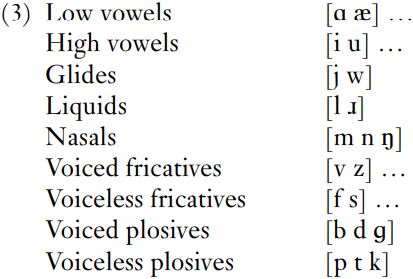
Sonority is generally the loudness of individual sounds; another way of thinking about it is that 'louder' sounds involve more continuous air release, i.e. less restriction of the vocal chords and mouth as they produce sounds. In fact, sounds are thought to form a hierarchy in this manner as follows:

An interesting property of sonority is that, near-universally among all languages, syllables tend to have higher sonority in the middle and lower sonority around the edges. This property explains why common syllable nuclei tend to be more sonorous sounds like vowels ("bob") or also more sonorous consonants like the <l> in the second syllable of <bottle> "bah-dl" or, in American English, like the <r> in <bird> "brd". It also explains why syllables like "grat" are acceptable in English, but syllables like "sktf" are not. Theoretically, what is most desirable are syllables that look like mountains, rising in sonority then dipping back down, as in this diagram of the word "splinter" (note that s+C is one of the few initial clusters in English that violates the sonority hierarchy):


The principle of balancing distinctiveness and ease still apply: while more sonorous sounds are easier to make, they are also less distinctive from one another because they have less occlusion and thus less unique air flow. As well, sonorous sounds are harder to make in sequence. So the sonority hierarchy allows languages to be distinct and easy at the same time. "Open syllables" are those that end in vowels; ending in consonants is less sonorous.

But Tolkien's languages have an odd property: they are extremely sonorous; which is to say, they use as many high-sonority sounds as possible. The opening lines to the Lord's prayer in Sindarin read: "Ae Adar nín i vi Menel / no aer i eneth lín / tolo i arnad lín / caro den i innas lin". Every vowel is between two consonants; and every consonant is high on the sonority hierarchy! And in fact, there are two! total voiceless plosives (in: tolo, caro), since that is the lowest rung on the hierarchy. The clusters are all at most two consonants, one of which is always a high-sonority sound like a nasal or liquid. About half of the syllables are open, which is extraordinarily high when compared to native English words (a fun exercise would be to count open and closed syllables in "Uncleftish Beholdings", a scientific article written wholly with native words). It is a similar, though less extreme, story with Quenya, e.g. "A Elbereth Gilthoniel / silivren penna míriel": note again the near-complete avoidance of voiceless plosives and the clusters all involving liquids or nasals. Were one to draw a chart of a given text in Elvish, there would not be mountains but rolling hills.

Compare the only known text in the Black Speech of Mordor, which Tolkien designed to be ugly and harsh: "Ash nazg durbatulûk / ash nazg gimbatul / ash nazg thrakatulûk agh burzum-ishi krimpatul." Almost every syllable is closed and/or has a stop and all words end in a consonant; note the complex and awkward consonant clusters. Oddly, Tolkien seems to dislike (the more sonorous) voiced fricatives like "gh" and "z", the former also because it is made far back in the mouth; so also with a dislike for "sh", which produces measurably much more turbulent air than "s" (as seen in e.g. a spectrogram). Perhaps this also explains his distaste for French, which has much of "z" and "v" and "zh" and whose "r" sound is more or less a guttural "gh". Tolkien preferred the less 'buzzy' unvoiced fricatives and the less turbulent, airy voiced stops. With a hand in front of the lips one can feel the rush of air in "ta" and the lack of air in "da," and with a hand on the throat one can feel the buzz of "zzz" and the silence of "sss." But there is a more precise measure of sonority.

The average sonority of different languages has been both studied and quantified. There appears to be a strong link between climate and sonority of language: the colder the clime, the less sonorous the tongue. Though it's very hard to find data directly comparing the languages Tolkien measured in his letters, one study (Maddieson 2018) did include Finnish and found that it was extraordinarily sonorous, scoring well above the included Indo-European languages completely bucking the cold climate trend. Another indicator of this is phonotactics (the permitted structure of syllables): while English allows up to CCCVCCCC (e.g. "strengths", phonetically s-t-r-E-ng-k-th-s) or 7 consonants for one vowel, Finnish only allows up to (C)V(C); and the more consonants, the less sonorous. Quenya and Sindarin both appear to be CVC, like Finnish or Italian but unlike English or French; Welsh appears to be (C)(C)V(C). But these measures are all rather non-numerical: a more serious scholar than I would use the methods in (Fought et al 2004) to compare with various languages Tolkien liked and disliked.

All this is not to say that Tolkien looked at vowel charts and read about the phonotactics of languages to decide his opinion on them. He listened to them, or read them, and made his decisions based on how the languages flowed. Did they run coarse, dragging and smashing into jagged consonants? Or did they flow from gentle, sonorous sound to clear vowel and back again, rolling in a rhythm as a boat rocking over small waves? A person may prefer thrill rides and harsh contrasts, or silken sailing and gentle rowing; Tolkien was a fan of fair weather and rolling hills.

-LN

The High Elves: Window to an Earlier Era


    The High Elves have always been some of the most memorable characters in The Lord of the Rings for me. The scenes they are in have a particular feeling to them—one of wonder and enchantment, but also the melancholy that the days of the elves are already passed. As Sam says, “there’s Elves and Elves…they’re not all all the same”—the High Elves are distinct even from the other elves we meet. In the past, though, I’ve often struggled to define exactly why the elves make such a strong impression upon me (and presumably other readers as well). Thus, I wanted to look more into both how exactly Tolkien was characterizing the experience of meeting the elves, but also how that explains my own impressions of them. In doing so, I found connections to a number of the themes we discussed this week in class. Though they are less explicitly stated than in The Notion Club Papers, Tolkien’s ideas of dreams, time, and language can all help explain why the High Elves “feel” like they do.

The first thing to note about two of the major scenes involving High Elves (when the hobbits meet Gildor’s company and when the Fellowship enters Lothlorien) is how multiple characters describe their experience as dreamlike. Sam walks alongside Gildor “as if in a dream”, and both he and Pippin don’t retain many memories of that night beyond strong sensations and impressions (Book I, Chapter 3). The elves even appear to shimmer as they walk, though they don’t carry lights. Similar sensations are noted in Lothlorien, where the Fellowship again don’t have a good grasp on passing time, and it feels like early spring despite it being winter (Book II, Chapter 7). 

Invoking the sensations of dreams makes the High Elves and their lands seem otherworldly and beyond the understanding of the hobbits. From that alone we learn how enchanting and alien the High Elves are to the other creatures of Middle Earth. But, if we consider Tolkien’s theories about dreams from The Notion Club Papers and other works, we can add another layer of depth to how the elves are understood.

Multiple Tolkien works connect dreams and time in some way. For instance, Ramer argues in The Notion Club Papers that a dreaming mind has the ability to move through time and space, and even see things it has not perceived in real life (175). That thread appears in other Tolkien works as well—in the opening chapters of The Lost Road, Alboin speaks in a dream with Elendil, “the father of many fathers before you.” Thus, Alboin has in a certain way traveled back in time, or at least made contact with a figure from the past. Dreaming is very clearly connected with experiencing other times, and extending that to The Lord of the Rings actually sharpens my understanding of how the elves come across. The High Elves are all tremendously old and from a different time; Frodo feels that Lothlorien “did not fade or change,” and that there he could hear seas and sea-birds that no longer existed (Book II, Chapter 6). The dreamlike description therefore also emphasizes how the High Elves are living relics of the past, and Lothlorien is a window into an earlier era. For me, at least, it adds a note of melancholy to the High Elves—engaging with them offers a glimpse into a reality that is already gone. 

To turn to another theme this week, Tolkien considered language to be an integral part of his stories. In Letter 163 he describes how The Lord of the Rings was conceived—one of the earliest inspirations was his study of languages. More specifically, he recalls feeling “intoxicated” after discovering Finnish, which then influenced the language he himself had created. To him, languages have a “flavor”; he states in Letter 180 that this flavor or character strongly influences the legends of a culture. Clearly, Tolkien sees language as key to creating and understanding any culture or people. This of course explains why there is so much attention paid to languages within The Lord of the Rings, but I think it also explains the reactions of some characters when meeting the elves. 

When Gildor invites the hobbits to travel with them, Frodo’s response (Elen sila lumenn’ omentielvo) is in high-elven speech. As a result of his knowledge of the elven tongue, Frodo ends up talking with the elves far more than the other hobbits and has a long conversation with Gildor about his journey (Book I, Chapter 3). Thus, Frodo’s use of the elvish language seemingly connects him to the world of the elves, enabling him to understand them better than his friends. A similar situation occurs in reverse in Lothlorien, where Galadriel’s use of the dwarvish language makes Gimli rethink his prejudice against the elves (Book II, Chapter 7). Especially in relation to the elves, it seems understanding a language makes characters more understanding of the broader culture, which seems a natural extension of Tolkien’s ideas that languages have such a strong influence on both real myths and cultures and those he created.

As for myself, I think Tolkien’s commentary on languages having “flavors” is actually quite useful in explaining why the elves are so distinct. I’m no linguist, but the elvish languages do give me very strong impressions about what the High Elves are like. For one, Tolkien clearly takes inspiration from many of the old European languages we listened to, making the languages (and thus the elves) seem as if they have a very long history. Furthermore, when compared to a language like Dwarvish, which sounds very guttural and earthy, elvish seems more … sophisticated? I struggle to come up with the proper words to describe it, but the concept of “flavor” seems very apt for explaining how the elvish languages so strongly characterize my impressions of them.

To return to Sam’s thoughts, he describes being in Lothlorien as “feel[ing] as if I was inside a song.” Given that many of the songs Tolkien presents in the books are historical epics and tales, this is a very fitting description. Like those types of songs, the High Elves seem to be a window into another time, and their language also characterizes both my and the hobbits’ impressions of them. Perhaps that is ultimately why the High Elves are so memorable to me—they are so deeply connected to the past in a series known for having an incredibly detailed history.   

-AS


Warning! Danger: Dreams, Incarnation, and Real Peril in Fairyland

Tolkien often refers to Fairyland as the “Perilous Realm,” where there are “pitfalls for the unwary and dungeons for the overbold” (On Fairy-stories). There is an inherent danger that comes with entering; it is not safe, and it is certainly not always comfortable. This danger is not illusory. In The Lost Road, Elendil warns Alboin that in accepting the chance to ‘go back,’ he “shall not be as one reading a book or looking in a mirror, but as one walking in living peril” (TLR 53). 

However, this ‘going back’ is facilitated by a dream. When Elendil first speaks to Alboin, Alboin is asleep in his bed, and the second time he enters Elendil’s world, he is asleep in his chair– in England. And, perhaps most tellingly, he is still there at the end of the adventure in Númenore: though the story was never finished, Tolkien left a note saying “Alboin is still precisely in his chair and Audoin just shutting the door,” exactly where he was before the dream began. 

This brings us to the question I have been grappling with: How can one be in real peril if the “Perilous Realm” is only a dream?

I am not sure I have come to a conclusive answer, but I think there is much to be gained from exploring dreams as language, the incarnation of language, and how incarnation relates to peril. 

In Tolkien’s stories, language and dreams function in a similar way: language is a mechanism for the transportation of ideas and meaning from one person to another, and a dream is a mechanism for the transportation of a mind into a different world (or in the case of Alboin, a different time). Both language and dreams act as portals, or pathways– arched doorways shining with letters and guarded by secrets, and often leading to uncomfortable places. 

In one of his Letters (180), Tolkien describes language as dependent upon the legends to which it belongs. Language needs stories, and it needs people to tell these stories; it needs embodiment, some kind of physical form (speech or writing done by people) in order to be a living language. As Ramer states in The Notion Club Papers, “language begins only with incarnation and not before it” (203). Dreams likewise require incarnation. Throughout the NCPs, Tolkien argues (through his characters) that though the mind’s attention may travel during dreams, it always remains inextricably linked to the body. Ramer again tells us: “Mind-body: they jump together, or neither jumps at all” (178). It is logical, then, to draw the conclusion that it is not only Alboin’s mind that undertakes the dream-adventure, but his body as well– and any “peril” he experiences in his dream will have an effect on him as a whole, mind and body both. 

It is in fact Alboin’s embodiment that makes the peril of the dream possible; one cannot experience peril without having something at stake, that something usually being his/her life. Furthermore, it is precisely this peril that makes the dream-world “Fairyland,” and perhaps more real than the waking world.

For example, when the hobbits are returning home to the Shire, Merry says, “It seems almost like a dream that has slowly faded,” and Frodo replies, “Not to me. . . . To me it feels more like falling asleep again.” Frodo has the feeling that his adventure, his part in the great tale or legend, was more “real” than his dream-like life in the Shire beforehand. The adventure brought with it high stakes and hardship, allowing Frodo to play a role in the battle of Good and Evil (peril!) that had previously seemed to him nothing more than a far-off myth. It is in this way that Alboin’s dream-world– his own legend that he finds himself in– could feel more “real” than the world of England. It is no surprise that Númenore, the world of Gods and prohibitions and world-altering decisions to be made, feels more like his “true country” (to borrow a phrase from Lewis) than a world where it is hard to see much significance in anything. In the dream-world, everything is heightened. 

I believe that when Alboin wakes up in his chair, he will not be unaltered. His brief journey into a different and heightened world will change how he acts and how he thinks, his body and his mind. Perhaps he will start to notice moments when the two worlds seem to merge and he can see himself as part of the story, the real story, happening even when England feels bland and life feels pointless. I think this is the way we are supposed to read fantasy tales like the Lord of the Rings. These stories are scary, and everything seems to matter astronomically; and yet we still want to be there, and we want to fight amidst the peril to be Good. It is our task to bring these alterations we find within ourselves back with us, so our journeys into Middle-earth are not fruitless. 

Ramer ends his story by telling how he woke up from his dream. When he focuses his attention on the planet Tekel-Mirim, everything stands still, and he realizes at once that he is looking at Oxford: “The clock on Saint Mary’s struck 7 a.m. – and I woke up for my appointment. To go to Mass. It was the morning of the feast of Saint Peter and Saint Paul, June 29th 1986, by our reckoning” (211). Tolkien takes us through a transition from one legend to another, from a subcreated dream-world to the true Legend of saints and sacrifice and bread becoming God embodied, and instead of having the feeling of “falling asleep again,” we have the feeling of waking up into a heightened world, where we are part of the True Story, perilous as it is. 

-LJE