Showing posts with label Language and Dreams. Show all posts

Saturday, April 4, 2026

What If Waking Life Is the Dream?

What if the world that feels concrete and ordinary is actually a dream? Tolkien suggests this at the end of The Lord of the Rings, when Merry says to Frodo that their adventure “seems almost like a dream that has slowly faded,” and Frodo replies “to me it feels more like falling asleep again.” This exchange quietly flips the way we usually think about dreams. In life, we often treat dreams as the thing that is unreal, the thing we leave behind when we wake up. But Frodo suggests the opposite. Maybe ordinary life is the dimmer state, and the journey has been more real. Once that idea comes to mind, it is hard to miss throughout Tolkien’s writing. Dreams in his work rarely feel like random psychology. They feel more like flashes of a deeper world, beyond normal perception. 

This idea builds early on with Frodo’s recurring dream of the Sea. In that dream, “he knew that it was not leaves, but the sound of the Sea far-off; a sound he had never heard in waking life, though it had often troubled his dreams.” What makes this so strange is that the dream contains knowledge Frodo does not have. He has never seen the Sea, and yet he recognizes it. The dream is not making something up. It is revealing something true before Frodo has experienced it for himself. Tolkien pushes that feeling further by giving the dream direction: Frodo sees “a tall white tower” and feels “a great desire” to climb it and look out toward the Sea. That does not feel like the usual loose logic of dreaming. It feels intentional, almost like a summons. The dream points beyond the Shire toward something larger that exists whether Frodo understands it or not. In that sense, dreams in Tolkien are not really escapes from reality. They are more like early contact with it. 

He progresses this idea at Tom Bombadil’s house, where Frodo has an experience that does not fit neatly into either sleep or waking. Tolkien writes that “either in his dreams or out of them, he could not tell which, Frodo heard a sweet singing running in his mind.” That uncertainty matters. By this point Tolkien is no longer treating dreams as things safely contained by sleep but experiences that spill into waking life. The song itself transforms what Frodo perceives. It “seemed to come like a pale light behind a grey rain-curtain…until at last it was rolled back, and a far green country opened before him under a swift sunrise.” What stands out here is the language of unveiling or revealing. Frodo is not simply inventing a place in his head, something is being uncovered. The dream is another way of seeing reality. 

If dreams in Tolkien let characters brush up against a deeper reality, language, especially poetic and Elvish language, often does the same thing. In Rivendell, Frodo listens to an Elvish song and slips into something dream-like. Tolkien says that “the interwoven words…even though he understood them little, held him in a spell,” and that “visions of far lands and bright things that he had never yet imagined opened out before him.” Frodo does not fully understand the words, but they still work on him. Meaning does not arrive first through explanation. It arrives through sound, rhythm, and atmosphere. The experience becomes “more and more dreamlike,” until Frodo feels carried away by “an endless river of swelling gold and silver…too multitudinous for its pattern to be comprehended.” Language here does not just describe another world. It opens one. Tolkien’s other writings make that idea even clearer. In The Lost Road, names are described as feeling real, as if they are discovered rather than invented. In The Notion Club Papers, dreams are treated like imperfect translations of a deeper reality breaking into the mind. Both ideas help explain what is happening in Rivendell. Language and dreams work in similar ways. In both cases, something is felt before it is fully understood. 

At the same time, Tolkien does not treat language as automatically good or comforting. It can open reality, but it can also trap and darken it. The Barrow-downs make that very clear. Frodo first hears only “a cold murmur, rising and falling,” but gradually “strings of words would now and again shape themselves: grim, hard, cold words, heartless and miserable.” Language here is no longer fluid or illuminating. It becomes oppressive. When the voice hardens into an incantation “Cold be hand and heart and bone, and cold be sleep under stone” the effect is almost physical. Frodo feels his own agency weakening, as if the words are imposing a frozen reality on him and the others. What breaks the spell, though, is language again. Frodo remembers Tom Bombadil’s rhyme and says, “Ho! Tom Bombadil!…for our need is near us!” As he does, his voice “seemed to grow strong.” One kind of language deadens the world while it seems that another can restore movement and life. 

The most complicated version of all this comes in Lothlórien, in the Mirror of Galadriel. The Mirror is not exactly a dream, but it behaves like one. Galadriel says it reveals “things that were, and things that are, and things that yet may be,” and adds that “which it is that he sees, even the wisest cannot always tell.” Frodo can’t always tell whether what he experiences belongs to the times when he is sleeping. Here he can’t even tell whether what he sees and experiences belongs to the past, the present, or the future. Even Sam’s vision moves “like a dream,” shifting before it can be fixed in place. This is also where The Notion Club Papers helps. In it Tolkien imagines dreams as partial and difficult translations of a reality that cannot be easily interpreted. The Mirror works the same way. It does not hand over neat truth but something partial, unstable, and easily misunderstood. But that doesn’t make it not real. Actually, Tolkien seems to suggest the opposite, that the deepest realities are often the hardest to solidify. 

By the time we return to Frodo’s final comment, it no longer feels like a strange line tossed in. When he says the journey feels “more like falling asleep again,” it’s what Tolkien has been building toward all along. Dreams, songs, visions, and more all offer partial access to a reality that lies beyond understanding. Waking life starts to look less like the stability we think of it as and more like one limited mode of experience. Dreams are moments when a very deep reality rushes closer to the surface. Language can do the same thing. Whether in Elvish song, incantation, or remembered rhyme, words do not simply report the world. They open it or distort it. If Frodo feels as though he is “falling asleep again,” it may be because he is returning to a world where that deeper reality is harder to perceive. A world where the dream has not ended, but has become harder to recognize. 

- ZSK 

What Remains: Language, Dreams, and the Fragmentary World of Tolkien

Looking at the works of Tolkien through the lens of language and dream help us situate the sense of reality behind his tales. But the very subjectivity of dreams and language also introduces a barrier of access. Both seem to offer access to something deeper: a past that is not constructed but inherited, not fully known but nonetheless recognized. At the same time, however, this access is neither stable nor universal. Because it depends on something as subjective as linguistic “taste” or the experience of dreams, it is never fully available but appears unevenly and under particular conditions. What emerges is not a continuous or complete reality, but one encountered in fragments, shaped not only by what survives, but by who is able, or willing, to perceive it.

We see language as a central part of Tolkien and understand it as a tool for building depth, but there is still this, often overshadowed, quiet function of language as a boundary. At the most obvious and lived level, language already separates those who can understand those that cannot. Yet, Tolkien complicates this by suggesting another less visible form of exclusivity: amongst those who understand, there is a distinct experience ties to each person. In The Lost Road, Alboin describes language as having a “flavour”, noting that “the languages he liked has a definite flavor”, (43) and that he is drawn in particular to the “Northern” one. This preference is not rational or fully explained, it is felt. It is not comprehension that matters but attraction. Tolkien reinforces this in Letter 163 to W.H. Auden, where he describes linguistic pleasure as something closer to appetite than intellect, “more like the appetite for a needed food” (312) and admits that Spanish is “the only Romance language that gives me a particular pleasure of which I am speaking of” (312). Language, then, is not neutral or equally available, it is experienced unevenly and shaped by what Tolkien calls “linguistic taste”, which “changes like everything else, as time goes on”, and which may even function as a “test of ancestry as blood-groups.” (313) The implication is that language carries with it a past that is not accessible to all, to responds to a language there seems to be the need to put effort to belong to it or be aligned with the history it carries. Tolkien, I believe unintentionally, leaves this subtle but quite significant distance, not everyone is equally positioned to access what a language preserves and therefore cannot all equally perceive the reality that emerges through it. So, language is not simply connecting us to the past but determining who is able to recognize it as such. 

Beyond language’s uneven form of access, The Lost Road also suggests that this access comes at a tradeoff. Alboin’s experience is marked beyond this attraction to certain “flavors”, but by a societal pressure away from them. Early on, he anticipates that “I shall dream tonight […] The Latin-mood will go,” (46) as if the two states cannot coexist, this contrast becomes sharper as he begins to advance within the structures of ordinary life. His father’s disapproval causes his response to the dreams as “Confound you dreams!” (46) seeming to be a rejection of the mode of experience that resists control and a shift toward discipline. This “Latin-mood”, then, comes to signify more than a preference but the societal expectation of orientation towards a certain language, and by means, a certain past. This shift is reinforced through Alboin’s increasing alignment with institutional life, he “had behaved himself moderately well at the university,” and the narrative retrospectively marks this period as coinciding with “the strange, sudden cessation of the Dreams.” (46) This again reassures us of the duality within society of abiding and learning languages (thereby histories) deemed worthy of society and those that we have true preference towards. Languages like Greek and Latin are presented in the Lost Roads as legitimized, having fragments worth unfolding. Thereby, access to these fragmentary, inherited forms of reality requires a certain openness, one that structured, forward-moving life tends to close off. The barrier, then, is not only linguistic or ancestral, but also self-impose. To move forward in one mode implicitly means to leave another behind. 

This leads us to the realm of dreams. Through Tolkien’s own imaginative material, we get the feeling that what is accessed is never whole. In Letter 257 to Colin Bailey, he keeps returning to what he calls “the dreadful dream of the ineluctable Wave,” something that “still occurs occasionally,” (486), that always ends in the same way of surrender without resolution. We see the themes of decadence constantly present in Tolkien’s worlds, and we can draw a line from the languages as a past that have left traces of a world that no longer pertains. Tolkien’s mythmaking comes from this repetition of something partial not necessarily grounded on a stable origin. This same structure extends into Middle earth itself. The world we encounter is not one coming into being, but one that has already passed its height. The movement toward Weathertop is marked by ruins, where past greatness is only available through what remains of it. Even spaces that seem to resist this decay, such as Bombadil’s house or later Lothlórien, do not offer permanence so much as interruption. They exist briefly outside time or power, but cannot be sustained, and the narrative moves on from them. What follows is not preservation, but this diminishment: the Shire returns altered and reduced, and the Grey Havens mark the point where what cannot be integrated into the present must leave it entirely.

What Tolkien ultimately reveals is not simply a hidden world, but a particular condition of access to it. Language distinguishes who can perceive it, social structures determine what is worth preserving, and dreams offer only partial returns of what has already been lost. Even the world itself, as it appears in The Lord of the Rings, does not present a complete reality, but one that persists through what remains after it. The past survives not as something fully recoverable, but as fragment, as echo, as repetition. What Tolkien’s work suggests is that there is more to reality than this, but it exists in forms we are not always prepared to sustain.

-LMN

Death and Decline

The passage of time is a defining characteristic of Tolkien’s Legendarium. As Arda grows older, a sense of diminishment is ever-present. From the destruction of Beleriand to the disappearance of the bloodlines of Numenor and the bending of the world, time brings a great sense of loss as the world changes. Knowing about Tolkien's recurring dream of a civilization-ending deluge, we can better understand the world that Tolkien has crafted in The Third Age as one existing in the remnants of a more noble and elegant past. The characters of the tales we love exist within their shadow. We notice its length through their perspective, whether it be the Fellowship of the Ring traveling through the long-deserted Kingdoms of Eregion (Hollin), Thorin’s Company observing the gloomy ruins of Arnor, or the bloodlines of Numenor dissipating within Gondor.  

If we were made to choose the race in Middle-earth that has the best grasp of the passage of time, we would undoubtedly pick the Elves. Their immortal nature allowed them to experience most of history, from their awakening under the stars to the end of the Third Age. However, their inability to accept the natural passage of time and their attempt to cling to it led to the creation of The Rings of Power, one of their greatest transgressions. Sauron plays on their desire to prevent the diminishment of their respective kingdoms, helping them craft rings that manipulate the flow of time within them.

A final chance at permanence is presented to Galadriel when Frodo offers her The One Ring. This gives her an opportunity to stop the oncoming decay of Lothlórien, as Frodo will either destroy the power of her current ring or, in failure, bring it under the control of Sauron. Ultimately, she forgoes her attachment to Middle-earth and accepts the inevitability of diminishment, “passing” her test and choosing to go into The West. Surrendering a chance at the ultimate power in a way redeems the earlier mistake of the Elves. Galadriel's decision represents the Elves' now fully putting their faith in the doom of the world and rejecting the opportunity to exert undue influence beyond their mandate, acknowledging that their time in Middle-Earth must come to an end and entrusting the fate of the world to men.  

Within the hearts of men, specifically Faramir and Boromir, we find a similar conflict to that faced by Galadriel and the Elves, as their reactions to dreams and the presence of The One Ring represent the dichotomy of choosing to remain faithful or falling short in the face of hopelessness. Boromir, influenced by his dream about Isildur's Bane, attempts to snatch The Ring from Frodo and use it as a weapon in hopes of saving Minas Tirith. In contrast, Faramir, who had the same dream, famously says he would not take it up even if  “Minas Tirith [was] falling in ruin and [he] alone could save her,” preferring to leave it “by the highway,” fearing it would turn him into a ruthless warlord, albeit a victorious one (Book IV, Ch, 5). His restraint allows Frodo and Sam to continue on their journey, resulting in the destruction of The Ring.

Faramir's temperance may be explained by another of his visions, the famous great wave over Numenor inherited from J.R.R. Tolkien himself and the characters from The Lost Road. When asked by Eowyn whether he fears an oncoming “Unescapable Darkness” similar to that which overtook Numenor in his dreams, Faramir responds that, despite reason telling him the end of days are near, he feels undeniable hope and joy in his heart, and that darkness will not endure (Book VI, Ch, 5). Faramir has put his belief in an ultimate resolution despite all that seems to be lost or deteriorated around him, refusing to let grief best him as it did his brother. Perhaps it is this strong faith in what is to come that protected him from The Ring’s seductive power, which plays on the desire to control one's own fate, which, for men, is death. Sauron succeeded in exploiting this disordered desire, sapping the faith of the men of Numenor in both The Lost Road and The Akallabeth (where it had been brewing before his arrival), promising them the ability to escape death, playing on their pride by offering a way to preserve their power through immortality. This ultimately delivers them straight to their fall and punishment. Similarly to Galadriel helping redeem the Elves, Faramir's decision not to take The One Ring, knowing it would lead to catastrophe, in a way, helps redeem not only his family but also the Men of Westernesse, of whom he is descended.  

Tolkien mentioned in his letter to Milton Waldman that while his stories don't explicitly include religion, they contain, in solution, “elements of moral and religious truth (or error)” (Letter 131). The ever-present feeling of decline and diminishment within the world feels like the aftermath of an Edenic fall from grace, with the plight of man growing with each passing century, taking them further and further away from the beautiful past. When viewed through the lens of decline, we can see why Tolkien wrote, in his letter to Herbert Schiro, that at the core of The Lord of the Rings is a story about “death and the desire for deathlessness” (Letter 203). To not accept death is to not have faith in or understand your role within the great tale, an attempt to influence the order of things out of an over-attachment to the world, which is what overcame both the Elves and Men of Numenor. Death is the fate of all men; its certainty stems from the inevitability of time. The decline within oneself matches that which permeates throughout Tolkien’s world. That decline creates a stark reality for the characters to face. The crushing nature of a long, drawn-out defeat tests their faith in the final victory and will to continue the struggle, and to do so by right means, even if they won't see it through, as Aragorn was prepared to do at The Black Gate or Theoden did at Pelennor Fields. The contrast of the resulting actions of the characters who remain steadfast and those who falter points to what Tolkien seems to have held to be an important truth: to maintain faith in ultimate victory in the face of despair and to play the right role suited to you during your allotted time.


-SDV

Friday, April 3, 2026

An Experiment with Dreams

I believe that considering J.R.R. Tolkien as a reader of An Experiment with Time can help us understand why Tolkien’s world felt for him—and countless readers—real. 

Traditionally, one could understand this “reality” of the story due to its basis on semi-historical events. “The Lost Road” is based on the legend of the Lombards, and the characters of the story existed at some point; this is described in great length as a commentary by Christopher Tolkien (The Lost Road and Other Writings, “The Lost Road: Commentary on Chapters I and II). Similarly, Tolkien describes the “beginning of the legendarium” as “an attempt to reorganize some of the Kalevala” (The Letters of J.R.R. Tolkien, 163). One could say that basing his own legends on existing legends and basing his own language on multiple existing languages makes Tolkien’s world feel more real. Even though modern understandings of legends tend to refute their accuracy, many agree that the bases of these stories are real, which makes legends at least partially real. 

But this isn’t what Tolkien seems to think, because Tolkien does not see himself as a creator of this world, but instead as a finder of it, as someone who brings his findings to light. One could call Tolkien an archeologist, who finds a deep, hidden truth and makes it public for all to see. 

In The Notion Club Papers, we are introduced to a group that creates stories, presumably fiction, but we are told by one of the characters, Ramer, that his seemingly fictitious stories are, in fact, real. As Ramer says, “I’ve never gone anywhere…But I suppose I could say that I’ve been in places…Yes, I’ve been to several strange places” (Sauron Defeated: The End of the Third Age, The Notion Club Papers, Part One). Tolkien himself is able to make at least part of the The Notion Club Papers real, since the end of the novel predicts the “Great Storm” of 1987, although the date of the storm is off by a few months. So, one could say Tolkien’s dream of the storm was largely accurate—that it was a vision or a prediction. Dunne’s work in An Experiment with Time is described as an account of precognitive dreams, or dreams which predict the future—the end of the The Notion Club Papers could be considered a precognitive dream.

And these types of dreams are present in much of Tolkien lore. For instance, take Boromir’s inspiration to head to Rivendell, a dream in which he hears a voice saying, 

Seek for the Sword that was broken:  

In Imladris it dwells; 

There shall be counsels taken

Stronger than Morgul-spells.

There shall be shown a token

That Doom is near at hand,

For Isildur’s Bane shall waken,

And the Halfling forth shall stand. (The Lord of the Rings, Book II, Chapter 2)

It is Boromir’s belief in this dream that forces him to search for said sword, upon his father’s counsel going to meet Elrond at Rivendell. It is indeed true that the Sword that was broken is in Rivendell (Imladris); it is accurate, as well, to say that Isildur’s bane (the One Ring) wakens again, i.e. is exerting its power, on Sauron, Gollum, and Frodo alike. Now, take instead Frodo’s dream in Tom Bombadil’s house, where he dreams of Gandalf’s rescue (LotR, Book I, Chapter 7; Book II, Chapter 2); Frodo’s dream is one of the past—a past whose memory he doesn’t have. Tolkien’s account of dreams can appear to be visions, showing fractions of the past or future, in the case of Boromir even becoming a prophecy. In a way, Tolkien’s distinction of dreams or visions is blurred, since visions are shown to sometimes be inaccurate and dreams are shown to be sometimes extremely accurate. As Galadriel Notes, “Remember that the Mirror shows many things, and not all have yet come to pass. Some never come to be, unless those that behold the visions turn aside from their path to prevent them” (LotR, Book II, Chapter 7). 

I believe that Tolkien’s explanation of dreams in his works, as well as his following of An Experiment with Time, can help explain why Tolkien believes that his stories were “given” to him, that he simply recording something that “was already 'there', somewhere: not of 'inventing’” (Letters, 131). Tolkien has a dream (which he includes in his writings) which is also dreamt by his son (Letters, 180); it would make sense then to think of the dream as containing some innate truth, of seeing or accessing another world through these dreams, such as it is described in The Notion Club Papers. But why is it that only this dream should be true? If this one dream is shared by others, it is possible that some of his other dreams are as well. And, if Tolkien believes dreams are real in this instance and that these are real also for hobbits, then is it possible they are real also for his own dreams of the Middle-earth? That is, it is possible that, since Tolkien considers his “creation” to really be findings, that he then believes these findings are real and that he has some sort of special access to these findings, since he has access to the Middle-earth and its languages. 

It may be that only Tolkien had the original access to this world, that no one else had a dream quite like his before his writings were released into the world. But, while we might have been once shut off from this world, Tolkien has given us a portal to access the Middle-earth through his books, a sort of palantíri that shows us a world far away, but in the past, or a Mirror that shows us a vision of what has already passed.

- CB

Saturday, April 1, 2023

Lay Phonaesthetics


Nomina debent naturis rerum congruere

Taste in languages resembles taste in other matters; which is to say, tastes are singular, individual, and often hard to explain. To examine them may be to cut the ball open for its bounce. Tolkien's are no exception. For example, in letter 213 Tolkien rather curiously asserts that he "dislike[d] French and prefer[red] Spanish to Italian," which is an almost total reversal of common opinion on the matter. Is French not famous as the language of love and beauty? Later he also states that he "love[d]... especially the Welsh language," but that "of the Irish language [he found] wholly unattractive," and in various places like letters 257 and 163, he states his favorite influences as Finnish, Welsh, and Gothic. And it is hard to deny these influences, looking at the extreme similarities between Quenya and Finnish and Sindarin and Welsh. But we shall attempt to examine a few matters in phonaesthetics, a word (likely) invented by Tolkien himself to mean "the aesthetic quality of sounds in language".

In the matter of linguistic beauty, Tolkien stood away from general consensus. The principle of "linguistic arbitariness" was cutting-edge in his day: it came onto the scene with Saussure in the late 19th c. and reached a peak in popularity with Chomsky in the mid 20th c. This principle states that the association between sound and meaning is necessarily arbitrary; according to this hypothesis, a TREE is a "tree" /tri:/ not because the phonemes /t/-/r/-/i:/ have some "tree-like" quality to them, but simply because the meaning TREE has been arbitrarily mapped onto those phonemes. 

As time has gone on, more cracks and caveats have appeared in this theory. The kiki-bouba effect is now quite widely known; the reader may explore that topic on their own if unfamiliar. A more intriguing, broader example would be another study found in the book Sound Symbolism pp. 76-93, in the study "Evidence for pervasive synesthetic sound symbolism in ethnozoological nomenclature" by Brent Berlin. The study examines bird and fish names in Huambisa, a native language of the Andes to which none of the participants had ever been exposed. In the following (abridged) list of pairs of fish and bird names, which ones are birds?

(1) chunchutkit, mauts; (2) chichikia, katan; (3) teres, takaikit; (4) yawarach, tuikcha; (5) waikia, kanuskin

(Answer: respectively first, first, second, second, and first)

Of the chosen example pairs above, 90+% of respondents correctly identified the bird name (though general participant accuracy was lower; around 58%, which was still very statistically significant given the number of responses). The study also concluded that bird names had more [i] (like in machine) and fish names had more [a] and [u], and theorized, based on other papers, the cause to be that [i] has a higher F0 (base frequency) than [a] and [u]. This tendency apparently extends both to onomatopoeia in other languages and even into the animal kingdom. 

So sounds do have meaning; but we have wandered. What, precisely, characterizes the sound-systems of Tolkien's invented languages? And is there sound-symbolism in such? For this we need two more discussions, respectively addressing vowels and consonants: that of "balance" in phonetic inventories and that of "sonority".

First, compare the inventories of contrasting sounds in both the following unnamed languages among those mentioned by Tolkien in his letters. The precise value of the symbols is irrelevant, since what matters is the distribution; but know that the parallelogram is a literal representation of the mouth:

Note that while many vowels are shared, the top right has many more vowels all bunched together; one might say (rather unprofessionally for a linguist) that the former space is completely cluttered. The vowels in the top right and bottom left are less spread out and less even across the space. That was likely Tolkien's conclusion, if at most subconsciously, for he preferred the top right (Finnish) and bottom left (Italian) to the top left (French) and bottom right (Irish). In an abstract sense: Tolkien preferred order or symmetry, and simplicity.

Two competing goals of language are to be 1) concise and 2) unambiguous. Since all sounds in the mouth are on a continuum, distinguishing between them (especially with any disturbance) requires that each be distinct. So languages tend to have systems with sounds that are 1) as plentiful as possible on the phonetic level, but 2) readily distinguished. Thus languages tend to spread apart their vowels, for clustering reduces ease in distinguishing them; and they also use as much of the vowel space as possible.

These are the vowels of Sindarin and Quenya:
Note first that they generally resemble a mix of the Italian system and the Finnish system; hence the vowels are few in number and spread throughout the space. English vowels have a strong tendency to become diphthongs (in fact, a 'Southern drawl' is mostly a tendency to turn single vowels into diphthongs); both languages are explicitly described as having 'pure' vowels like in Italian. 

While consonant systems can be viewed through a similar lens of balance and distribution, Sindarin's consonant inventory is near exactly that of Welsh, and Quenya's is more or less nondescript (though this does mean both are naturalistic inventories). A discussion of the distribution of consonants will be more productive.

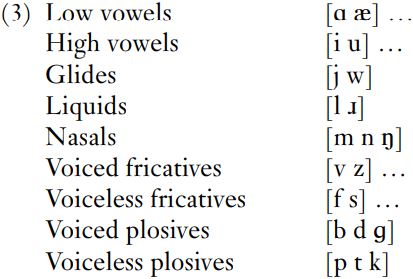
Sonority is generally the loudness of individual sounds; another way of thinking about it is that 'louder' sounds involve more continuous air release, i.e. less restriction of the vocal chords and mouth as they produce sounds. In fact, sounds are thought to form a hierarchy in this manner as follows:

An interesting property of sonority is that, near-universally among all languages, syllables tend to have higher sonority in the middle and lower sonority around the edges. This property explains why common syllable nuclei tend to be more sonorous sounds like vowels ("bob") or also more sonorous consonants like the <l> in the second syllable of <bottle> "bah-dl" or, in American English, like the <r> in <bird> "brd". It also explains why syllables like "grat" are acceptable in English, but syllables like "sktf" are not. Theoretically, what is most desirable are syllables that look like mountains, rising in sonority then dipping back down, as in this diagram of the word "splinter" (note that s+C is one of the few initial clusters in English that violates the sonority hierarchy):


The principle of balancing distinctiveness and ease still apply: while more sonorous sounds are easier to make, they are also less distinctive from one another because they have less occlusion and thus less unique air flow. As well, sonorous sounds are harder to make in sequence. So the sonority hierarchy allows languages to be distinct and easy at the same time. "Open syllables" are those that end in vowels; ending in consonants is less sonorous.

But Tolkien's languages have an odd property: they are extremely sonorous; which is to say, they use as many high-sonority sounds as possible. The opening lines to the Lord's prayer in Sindarin read: "Ae Adar nín i vi Menel / no aer i eneth lín / tolo i arnad lín / caro den i innas lin". Every vowel is between two consonants; and every consonant is high on the sonority hierarchy! And in fact, there are two! total voiceless plosives (in: tolo, caro), since that is the lowest rung on the hierarchy. The clusters are all at most two consonants, one of which is always a high-sonority sound like a nasal or liquid. About half of the syllables are open, which is extraordinarily high when compared to native English words (a fun exercise would be to count open and closed syllables in "Uncleftish Beholdings", a scientific article written wholly with native words). It is a similar, though less extreme, story with Quenya, e.g. "A Elbereth Gilthoniel / silivren penna míriel": note again the near-complete avoidance of voiceless plosives and the clusters all involving liquids or nasals. Were one to draw a chart of a given text in Elvish, there would not be mountains but rolling hills.

Compare the only known text in the Black Speech of Mordor, which Tolkien designed to be ugly and harsh: "Ash nazg durbatulûk / ash nazg gimbatul / ash nazg thrakatulûk agh burzum-ishi krimpatul." Almost every syllable is closed and/or has a stop and all words end in a consonant; note the complex and awkward consonant clusters. Oddly, Tolkien seems to dislike (the more sonorous) voiced fricatives like "gh" and "z", the former also because it is made far back in the mouth; so also with a dislike for "sh", which produces measurably much more turbulent air than "s" (as seen in e.g. a spectrogram). Perhaps this also explains his distaste for French, which has much of "z" and "v" and "zh" and whose "r" sound is more or less a guttural "gh". Tolkien preferred the less 'buzzy' unvoiced fricatives and the less turbulent, airy voiced stops. With a hand in front of the lips one can feel the rush of air in "ta" and the lack of air in "da," and with a hand on the throat one can feel the buzz of "zzz" and the silence of "sss." But there is a more precise measure of sonority.

The average sonority of different languages has been both studied and quantified. There appears to be a strong link between climate and sonority of language: the colder the clime, the less sonorous the tongue. Though it's very hard to find data directly comparing the languages Tolkien measured in his letters, one study (Maddieson 2018) did include Finnish and found that it was extraordinarily sonorous, scoring well above the included Indo-European languages completely bucking the cold climate trend. Another indicator of this is phonotactics (the permitted structure of syllables): while English allows up to CCCVCCCC (e.g. "strengths", phonetically s-t-r-E-ng-k-th-s) or 7 consonants for one vowel, Finnish only allows up to (C)V(C); and the more consonants, the less sonorous. Quenya and Sindarin both appear to be CVC, like Finnish or Italian but unlike English or French; Welsh appears to be (C)(C)V(C). But these measures are all rather non-numerical: a more serious scholar than I would use the methods in (Fought et al 2004) to compare with various languages Tolkien liked and disliked.

All this is not to say that Tolkien looked at vowel charts and read about the phonotactics of languages to decide his opinion on them. He listened to them, or read them, and made his decisions based on how the languages flowed. Did they run coarse, dragging and smashing into jagged consonants? Or did they flow from gentle, sonorous sound to clear vowel and back again, rolling in a rhythm as a boat rocking over small waves? A person may prefer thrill rides and harsh contrasts, or silken sailing and gentle rowing; Tolkien was a fan of fair weather and rolling hills.

-LN

The High Elves: Window to an Earlier Era


    The High Elves have always been some of the most memorable characters in The Lord of the Rings for me. The scenes they are in have a particular feeling to them—one of wonder and enchantment, but also the melancholy that the days of the elves are already passed. As Sam says, “there’s Elves and Elves…they’re not all all the same”—the High Elves are distinct even from the other elves we meet. In the past, though, I’ve often struggled to define exactly why the elves make such a strong impression upon me (and presumably other readers as well). Thus, I wanted to look more into both how exactly Tolkien was characterizing the experience of meeting the elves, but also how that explains my own impressions of them. In doing so, I found connections to a number of the themes we discussed this week in class. Though they are less explicitly stated than in The Notion Club Papers, Tolkien’s ideas of dreams, time, and language can all help explain why the High Elves “feel” like they do.

The first thing to note about two of the major scenes involving High Elves (when the hobbits meet Gildor’s company and when the Fellowship enters Lothlorien) is how multiple characters describe their experience as dreamlike. Sam walks alongside Gildor “as if in a dream”, and both he and Pippin don’t retain many memories of that night beyond strong sensations and impressions (Book I, Chapter 3). The elves even appear to shimmer as they walk, though they don’t carry lights. Similar sensations are noted in Lothlorien, where the Fellowship again don’t have a good grasp on passing time, and it feels like early spring despite it being winter (Book II, Chapter 7). 

Invoking the sensations of dreams makes the High Elves and their lands seem otherworldly and beyond the understanding of the hobbits. From that alone we learn how enchanting and alien the High Elves are to the other creatures of Middle Earth. But, if we consider Tolkien’s theories about dreams from The Notion Club Papers and other works, we can add another layer of depth to how the elves are understood.

Multiple Tolkien works connect dreams and time in some way. For instance, Ramer argues in The Notion Club Papers that a dreaming mind has the ability to move through time and space, and even see things it has not perceived in real life (175). That thread appears in other Tolkien works as well—in the opening chapters of The Lost Road, Alboin speaks in a dream with Elendil, “the father of many fathers before you.” Thus, Alboin has in a certain way traveled back in time, or at least made contact with a figure from the past. Dreaming is very clearly connected with experiencing other times, and extending that to The Lord of the Rings actually sharpens my understanding of how the elves come across. The High Elves are all tremendously old and from a different time; Frodo feels that Lothlorien “did not fade or change,” and that there he could hear seas and sea-birds that no longer existed (Book II, Chapter 6). The dreamlike description therefore also emphasizes how the High Elves are living relics of the past, and Lothlorien is a window into an earlier era. For me, at least, it adds a note of melancholy to the High Elves—engaging with them offers a glimpse into a reality that is already gone. 

To turn to another theme this week, Tolkien considered language to be an integral part of his stories. In Letter 163 he describes how The Lord of the Rings was conceived—one of the earliest inspirations was his study of languages. More specifically, he recalls feeling “intoxicated” after discovering Finnish, which then influenced the language he himself had created. To him, languages have a “flavor”; he states in Letter 180 that this flavor or character strongly influences the legends of a culture. Clearly, Tolkien sees language as key to creating and understanding any culture or people. This of course explains why there is so much attention paid to languages within The Lord of the Rings, but I think it also explains the reactions of some characters when meeting the elves. 

When Gildor invites the hobbits to travel with them, Frodo’s response (Elen sila lumenn’ omentielvo) is in high-elven speech. As a result of his knowledge of the elven tongue, Frodo ends up talking with the elves far more than the other hobbits and has a long conversation with Gildor about his journey (Book I, Chapter 3). Thus, Frodo’s use of the elvish language seemingly connects him to the world of the elves, enabling him to understand them better than his friends. A similar situation occurs in reverse in Lothlorien, where Galadriel’s use of the dwarvish language makes Gimli rethink his prejudice against the elves (Book II, Chapter 7). Especially in relation to the elves, it seems understanding a language makes characters more understanding of the broader culture, which seems a natural extension of Tolkien’s ideas that languages have such a strong influence on both real myths and cultures and those he created.

As for myself, I think Tolkien’s commentary on languages having “flavors” is actually quite useful in explaining why the elves are so distinct. I’m no linguist, but the elvish languages do give me very strong impressions about what the High Elves are like. For one, Tolkien clearly takes inspiration from many of the old European languages we listened to, making the languages (and thus the elves) seem as if they have a very long history. Furthermore, when compared to a language like Dwarvish, which sounds very guttural and earthy, elvish seems more … sophisticated? I struggle to come up with the proper words to describe it, but the concept of “flavor” seems very apt for explaining how the elvish languages so strongly characterize my impressions of them.

To return to Sam’s thoughts, he describes being in Lothlorien as “feel[ing] as if I was inside a song.” Given that many of the songs Tolkien presents in the books are historical epics and tales, this is a very fitting description. Like those types of songs, the High Elves seem to be a window into another time, and their language also characterizes both my and the hobbits’ impressions of them. Perhaps that is ultimately why the High Elves are so memorable to me—they are so deeply connected to the past in a series known for having an incredibly detailed history.   

-AS


Warning! Danger: Dreams, Incarnation, and Real Peril in Fairyland

Tolkien often refers to Fairyland as the “Perilous Realm,” where there are “pitfalls for the unwary and dungeons for the overbold” (On Fairy-stories). There is an inherent danger that comes with entering; it is not safe, and it is certainly not always comfortable. This danger is not illusory. In The Lost Road, Elendil warns Alboin that in accepting the chance to ‘go back,’ he “shall not be as one reading a book or looking in a mirror, but as one walking in living peril” (TLR 53). 

However, this ‘going back’ is facilitated by a dream. When Elendil first speaks to Alboin, Alboin is asleep in his bed, and the second time he enters Elendil’s world, he is asleep in his chair– in England. And, perhaps most tellingly, he is still there at the end of the adventure in Númenore: though the story was never finished, Tolkien left a note saying “Alboin is still precisely in his chair and Audoin just shutting the door,” exactly where he was before the dream began. 

This brings us to the question I have been grappling with: How can one be in real peril if the “Perilous Realm” is only a dream?

I am not sure I have come to a conclusive answer, but I think there is much to be gained from exploring dreams as language, the incarnation of language, and how incarnation relates to peril. 

In Tolkien’s stories, language and dreams function in a similar way: language is a mechanism for the transportation of ideas and meaning from one person to another, and a dream is a mechanism for the transportation of a mind into a different world (or in the case of Alboin, a different time). Both language and dreams act as portals, or pathways– arched doorways shining with letters and guarded by secrets, and often leading to uncomfortable places. 

In one of his Letters (180), Tolkien describes language as dependent upon the legends to which it belongs. Language needs stories, and it needs people to tell these stories; it needs embodiment, some kind of physical form (speech or writing done by people) in order to be a living language. As Ramer states in The Notion Club Papers, “language begins only with incarnation and not before it” (203). Dreams likewise require incarnation. Throughout the NCPs, Tolkien argues (through his characters) that though the mind’s attention may travel during dreams, it always remains inextricably linked to the body. Ramer again tells us: “Mind-body: they jump together, or neither jumps at all” (178). It is logical, then, to draw the conclusion that it is not only Alboin’s mind that undertakes the dream-adventure, but his body as well– and any “peril” he experiences in his dream will have an effect on him as a whole, mind and body both. 

It is in fact Alboin’s embodiment that makes the peril of the dream possible; one cannot experience peril without having something at stake, that something usually being his/her life. Furthermore, it is precisely this peril that makes the dream-world “Fairyland,” and perhaps more real than the waking world.

For example, when the hobbits are returning home to the Shire, Merry says, “It seems almost like a dream that has slowly faded,” and Frodo replies, “Not to me. . . . To me it feels more like falling asleep again.” Frodo has the feeling that his adventure, his part in the great tale or legend, was more “real” than his dream-like life in the Shire beforehand. The adventure brought with it high stakes and hardship, allowing Frodo to play a role in the battle of Good and Evil (peril!) that had previously seemed to him nothing more than a far-off myth. It is in this way that Alboin’s dream-world– his own legend that he finds himself in– could feel more “real” than the world of England. It is no surprise that Númenore, the world of Gods and prohibitions and world-altering decisions to be made, feels more like his “true country” (to borrow a phrase from Lewis) than a world where it is hard to see much significance in anything. In the dream-world, everything is heightened. 

I believe that when Alboin wakes up in his chair, he will not be unaltered. His brief journey into a different and heightened world will change how he acts and how he thinks, his body and his mind. Perhaps he will start to notice moments when the two worlds seem to merge and he can see himself as part of the story, the real story, happening even when England feels bland and life feels pointless. I think this is the way we are supposed to read fantasy tales like the Lord of the Rings. These stories are scary, and everything seems to matter astronomically; and yet we still want to be there, and we want to fight amidst the peril to be Good. It is our task to bring these alterations we find within ourselves back with us, so our journeys into Middle-earth are not fruitless. 

Ramer ends his story by telling how he woke up from his dream. When he focuses his attention on the planet Tekel-Mirim, everything stands still, and he realizes at once that he is looking at Oxford: “The clock on Saint Mary’s struck 7 a.m. – and I woke up for my appointment. To go to Mass. It was the morning of the feast of Saint Peter and Saint Paul, June 29th 1986, by our reckoning” (211). Tolkien takes us through a transition from one legend to another, from a subcreated dream-world to the true Legend of saints and sacrifice and bread becoming God embodied, and instead of having the feeling of “falling asleep again,” we have the feeling of waking up into a heightened world, where we are part of the True Story, perilous as it is. 

-LJE

Friday, March 31, 2023

Unraveling the Enchantment: Why Tolkien Opted for Dreams as a Portal to the Past and Future

 As a child, I was entranced by the depiction of the elvish civilization in Tolkien's works, and have since pondered what makes it so captivating. Initially, I had believed that the Elvish art depicted in Peter Jackson's films was what captivated me.  Jackson masterfully utilized Art Nouveau as the main style for Elvish architecture in Rivendell, with its flowing curves and colors that evoke a sense of connection to nature and moral goodness, characteristic of the “Firstborn". Upon further reflection, I came to the realization that Tolkien likely did not intend for the beauty of Elvish craftsmanship, marvels, or even magic to be the core elements that captivate those “Elf-friends”. But if not those, then what exactly does? I believe that this question is closely tied to why Tolkien selected dreams as a means to revisit the past and foresee the future. As a result, I will commence my discussion by delving into potential answers to this inquiry.


Before answering this question,  I would like to present an alternative version of time travel for "The Lost Road," which we can then compare to the original. Here's the story:


As the persecution of the Faithful by the King's party intensifies, Elendil grows increasingly anxious that their cause will soon come to an end. To preserve their legacy, he seeks a way to pass on their fight. With the assistance of the Eldar from the West, he creates a device that allows him to communicate with Alboin and share his story.


I'm curious to know what you think about this "who lives, who dies, who tells your story" plot. Although some may argue that it fills a gap by explaining how Alboin can suddenly speak words he never thought he'd say, I strongly believe that introducing such a plot risks undermining everything Tolkien aimed to accomplish with his work. To understand this point, we may first notice the similarities between this plot and plots in films like Interstellar. While Interstellar may be considered a classic in science fiction, it is still just that - a work of science fiction. Remember that Tolkien is regarded as a giant in the realm of fantasy, as opposed to science fiction. What is the difference in essence? Drawing from my own reading experience, I have observed that science fiction writers like Jules Verne often exhibit a deep admiration for human technology, while also conveying a sense of disenchantment with our world based on it. As readers of Tolkien, we can observe this sense of "disenchantment" portrayed in The Lord of the Rings through Saruman's destruction of Fangorn (To Saruman, Trees are just trees), and this is everything that Tolkien is against. Taking into account this perspective, we can approach the question more closely: What is the true enchantment of the elvenland and, more broadly, Tolkien's fantasy? And what are the elements that an "elf-friend" is expected to discover and adore during “their perilous journey”? In my opinion, the true enchantment lies in the creation and the gift of Eru, which is unlike anything from elf, human, or Sauron.


This leads to another question: what are the specific creations and gifts from Eru, and how are they connected to Tolkien's choice of using dreams as a "portal" for time-traveling?

The first and perhaps most fundamental gift from Eru is the gift of life itself. This encompasses both the physical and spiritual forms of life, and it is a gift that should be respected and cherished by all beings. Therefore, the act considered as Melkor's most unforgivable crime is his corruption of the Elves into Orcs. The portrayal of time machines, such as the TARDIS in Doctor Who, in science fiction often suggests that they pose a risk of altering the life form of their passengers during transportation (taking the case of River Song as an example), whether it be physical or spiritual. This concept runs contrary to the belief in Tolkien's works that the creation of Eru should not be violated. However, dreams offer a perfect sandbox where one can experience, learn, and feel without changing anything in either world.


The other gifts bestowed by Eru are highly dependent on the individual recipients. As suggested in Le Roman de la Rose:


Some say that there’s nothing in dreams

But lies and fables; however, one may

Have dreams which are not in the least

Deceitful, but which later become clear.


Apacen (Foresight) are among the gifts reserved for a select few Elves and Men. Dreams and visions serve as the natural means through which these gifts are expressed and utilized: Idril Celebrindal dreams about the fall of Gondolin and prepares a secret way for exodus; In the film, Arwen Undómiel, despite foreseeing both death and life on her path, chooses to continue on her journey.  These are the most enchanting moments in Tolkien’s world. 


There are more gifts bestowed upon ordinary mortals that are equally beautiful. In dreams, we often experience a feeling of déjà vu. This feeling may be the inspiration for the parallel scenes in The Lost Road; Another remarkable gift from Eru is the ability to choose to carry our loss, longing, and pain with us, and to transform them into our fantasies and dreams. Without such gift, how could Tolkien create Nirnaeth Arnoediad (Battle of Unnumbered Tears) and the Dance of Tinúviel?


Dream is a gift and may be the last comfort for the wanderers crossing oceans of time and space. -Y.P.L


Friday, April 17, 2020

The Nature of Language

            For many of us, language probably feels like something innate, something we don’t remember a time without possessing. Speaking in our respective native tongues can feel oddly natural, as if that is the language we are meant to speak. Many of us even have favorite languages (I am no exception to the rule) and while sometimes we can say why a language might appeal to us, be it the sound, the structure, or the way it rolls off the tongue, there is also an inherent quality to a language that makes it so appealing, something I would argue that can’t be explained. I know for me that saying something in one language may feel more “right” than in another; some words just feel more correct in one tongue than in a different one, even if perfectly translated. It’s like trying to describe what the color red looks like to someone else; you can point to an object that is red, but there is no real way to easily and conclusively describe the color red. At the same time however, we were not born with an inherent understanding of any language. While we may not, as previously mentioned, remember a time without it, we had to learn how to speak it, and someone had to make the conscious effort to teach us. With all that being said, this brings us to a question that arises from much of Tolkien’s work: is language, and the love of it, innate and unique for each of us, or is it just another learned behavior, that, by virtue of it being taught so early, just has the appearance of being hard-wired for every single person?
            The main argument for language being inherently separate from us, or in other words, something that we are not born knowing, lies in the way Tolkien described not only his passion for languages, but also the way in which he created them. For example, in letter 257 in The Letters of J.R.R. Tolkien, he says, “I began the construction of languages in early boyhood: I am primarily a scientific philologist. My interests were, and largely remain, scientific” (345). Here we see the study of language, and also the creation of language, boiled down to a science; for language to merit its own subgenre of scientific study, it seems as if at least part, if not all of it, must be inherently separate from people; we were not born with language, we came into it. Also, from Letters, in this case 131, he describes more specifically the invention of Elvish tongues,
“But I have never stopped, and of course, as a professional philologist…I have changed in taste, improved in theory, and probably in craft. Behind my stories is now a nexus of languages (mostly only structurally sketched). But to those creatures which in English I call misleadingly Elves are assigned two related languages more nearly completed, whose history is written, and whose forms…are deduced scientifically from a common origin…This gives a certain character (a cohesion, a consistency of linguistic style, and an illusion of historicity) to the nomenclature, or so I believe, that is markedly lacking in other comparable things” (143-144).
This shows explicitly that creating languages is very much a scientific process; they are not formed from an innate sense of style or aesthetic, but instead using broadly applicable and universal rules of form and grammar and forming a language from it. However, in some of Tolkien’s other writings, while they are fiction, he describes the possibility of language being innate to each person. The two most notable examples of this are in his Notion Club Papers and in The Lost Road. While the former is not mainly based around language, and instead around potential time and space travel, there is an important section of dialogue that ties into the idea of being born with a knack for language,
“’Well, if you really want to know what these names are,’ said Ramer, ‘I think they’re my native language…We each have a native language of our own – at least potentially. In working-dreams people who have a bent that way may work on it, develop it…It may be no more than giving a personal twist to the shape of old words; it may be the invention of new words (on received models, as a rule); or it may come to the elaboration of beautiful languages of their own in private…’But the inherited, first-learned, language – what is usually mis-called “native” – bites in early and deep. It is hardly possible to escape from its influence. And later-learned languages also affect the natural style, coloring a man’s linguistic taste; the earlier learned the more so…In language-invention, though you may seem to build only out of material taken from other acquired tongues, it is those elements most near to your native style that you select” (201-202).
Whether Ramer, the character speaking in this passage, is supposed to represent Tolkien or not when he describes native languages is beside the point; authors inject some of themselves, either wittingly or unwittingly, into their stories. Considering the large role that philology plays in this character’s story, it is likely that Tolkien used Ramer as a vehicle to express what in his mind may have been the foundation of language; the languages we speak are not native to us, but there is something inside us that is. Not everyone may be able to find it, but some will. In a similar vein, much like Ramer makes this discovery in a dream, so does Alboin in The Lost Tales. While in school he learns many classical languages like Greek and Latin, when he is dreaming or lost in thought he, without any conscious effort, starts to learn new languages piecemeal,
“And the Dreams. They came and went. But lately they had been getting more frequent, and more – absorbing. But still tantalizingly linguistic. No tale, no remembered pictures; he wanted to see, very much, and would give much to see and hear again – and these fragments of words, sentences, verses. Eressëan as he called it as a boy – though he could not remember why he had felt so sure that that was the proper name – was getting pretty complete” (49). Much like with Tolkien, for Alboin, the story came second, but the language came first. I would argue that maybe neither Ramer nor Alboin individually are a good representation of Tolkien; but perhaps when combined, they reveal what Tolkien truly believed about language; they can be studied as separate from us, and viewed as a collective creation of humanity, but inside each and every one of us is, maybe not a fully-fledged language of our own, but an intuitive understanding of the importance and beauty of language, something that is different for each and every one of us.

 - SGK

Smith of Wootton Major: Allegory or not?

In reading Tolkien’s Smith of Wootton Major, one comes across many characters and trinkets, and a small town in which deeper meaning, or perhaps even deeper allegory, seems to be found. Tolkien himself was not too fond of the whole, “allegory of the sort ‘five wizards = five senses’” (Letters, 203), however he then also explains that while this simple allegory is not in his way of thinking, the fact “that there is no allegory does not, of course, say there is no applicability” (Letters, 203). First one must discuss whether allegory must be this 1:1 ratio, or if it can be searched and dug into for deeper layers of meaning. Certainly, in Tolkien’s writing, there is no simple “Orcs ‘are’ Communists”, however many traits are found in all of the races of Middle-earth that are applicable to themes of the greater universe, and of course to what extent that Middle-earth is in our universe. Is this applicability not just a more complicated allegory?

Another point of allegory that must be discussed is if the intentions of the author or creator of the story determine whether allegory can be found and named as such. Tolkien did not intend on creating allegory, for he wrote that he had “very little particular, conscious, intellectual intention in mind at any point” (Letters, 163). He also writes that he finds “‘interpretations’ quite amusing,” of course excepting, “any ‘interpretations’ in the mode of simple allegory; that is, the particular and topical,” (Letters, 163). Needless to say, Tolkien rejects simple allegory of his own work. He does admit, however, that “it is I suppose impossible to write any ‘story’ that is not allegorical in proportion as it ‘comes to life’; since each of us is an allegory, embodying in a particular tale and clothes in the garments of time and place, universal truth and everlasting life,” (Letters, 163). In writing this, he concedes that his works may, in fact, have allegory. In this statement, he grants the possibility that allegory is often found where it is not intended, in the stories and the words that make up us all. It is impossible to escape from the kind of allegory that arises from life. Anything can be compared to anything, and interpretations of stories will exist from now until forever.

Bearing all this in mind, is The Smith of Wootton Major an allegory? Certainly the relationship between Alf, the King of Faery, and the old Master Cook Nokes, and also between Alf and the Smith, or Starbrow, the Elf-friend, lend to some greater themes of life. The character of the old Nokes, almost a caricature of the close-minded, old, lazy, sly characteristics that Tolkien gives him, can certainly be applied to the world. Furthermore, the lessons we learn from Nokes, or more precisely learn because of his disrespectful actions, about how to respect powers we do not understand and to be open minded to what mysteries the world can offer, lead us to think about ourselves in relation. The character of Starbrow, the lonely wanderer with some fantastical glow about him and a light in his eyes, also teaches the reader many things. He teaches the observer to look at the wider world, and the majesty and mystery of it all, however thanks to the Faery King, we also learn when to move on, and when to give up that connection to Faery and pass it to the new generation.

This one point of the story, when the Faery King asks Starbrow to give back the star so that it can be passed to another young child, is very interesting due to its similarity with Gandalf and Bilbo, and the one ring. Smith has this reluctance to give away his ‘passport’ to all of Faery, just as Bilbo is reluctant to pass on the ring to Frodo. Of course, the two objects, the Faery star and the evil magic ring, are two opposite magical items. The star gives Starbrow a chance to travel to and see the mysteries of Faery, and he will miss the light that made him wiser. Bilbo is mainly reluctant to give up the ring because of the evil power it holds, however it holds a similar place in his life as the star in Smith’s. It gave him some power to see beyond, to be a part of Faery. Of course, this allegorical paragraph is entirely what Tolkien would not have wanted, except that it is not exactly a 1:1 ratio. Gandalf is certainly not the King of Faery, however magical and mysterious he may be, and while he does serve a similar role, and the Hobbits of the shire are just as unwelcoming to Gandalf as perhaps Nokes is to his Prentice and all of Prentice’s ideas and opinions. However, none of these comparisons are equating any one part of the story to another. The star and the ring are fundamentally different, and their power affects the user differently, and while Gandalf seems to be all-knowing at first, soon the limitations of his power and knowledge, and the creatures beyond him are exposed, yet the Faery King still holds his mysteries and still holds a different role in Wootton Major. These stories were not intended to be allegories of each other, they stand separately.

With all this in mind, the conclusion is that yes, indeed, Smith of Wootton Major is in fact an allegory. It is an allegory for the beginning of the Lord of the Rings, it is an allegory for finding wonder and majesty in life, and about knowing when to move on. It is also an allegory for so many other deeper meanings, to any that can be found. Tolkien was very happy about applications of his world to our world, and the way he uses application is the same way some use allegory, to some deeper, layered truth, to help find symbolism and meaning in all the stories in the world. 

-CS